


Endotoxin-Free Plasmid DNA in Research Workflows

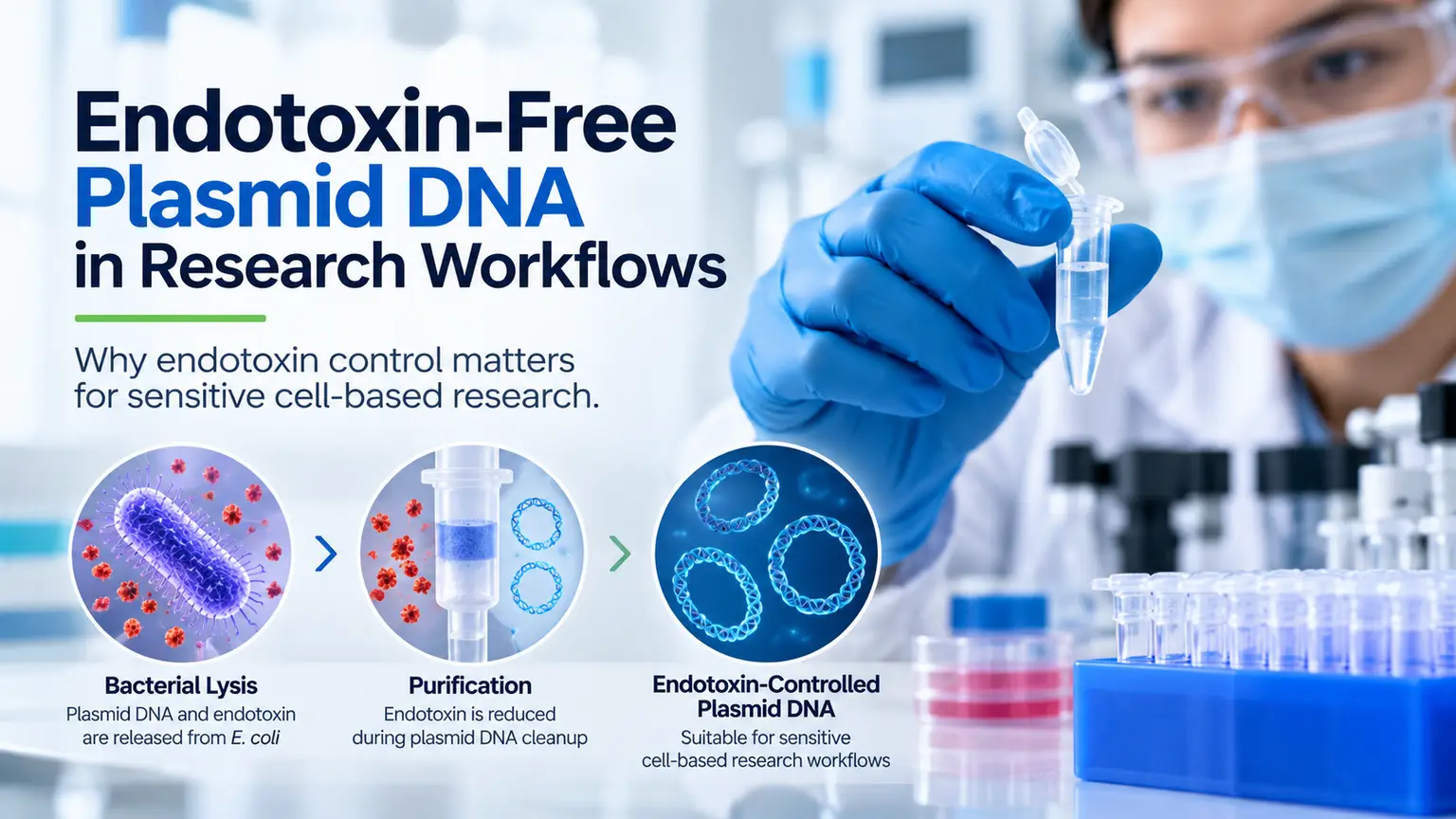
A plasmid preparation can show an acceptable concentration, A260/A280 ratio, and restriction digest pattern yet still compromise a sensitive cell-based experiment. Endotoxin-free plasmid DNA addresses a contaminant that is not reliably identified by standard nucleic acid purity ratios: bacterial lipopolysaccharide (LPS), commonly called endotoxin.
For researchers working with mammalian cells, primary cells, immune-responsive models, or in vivo research systems, controlling endotoxin can be as important as confirming plasmid identity, concentration, and DNA integrity.
Plasmid DNA isolated from Escherichia coli can carry endotoxin originating from the bacterial outer membrane through lysis and purification. When residual endotoxin enters a transfection workflow, it may induce inflammatory signaling, affect cell viability or proliferation, and complicate interpretation of reporter, expression, or functional assay data. The significance depends on the cell model, DNA dose, delivery method, and experimental endpoint.
Why Endotoxin-Free Plasmid DNA Matters
Endotoxin is a biologically active component of the outer membrane of Gram-negative bacteria. In research systems, it can activate innate immune pathways, particularly in responsive cell types. The resulting effects may include cytokine production, stress signaling, metabolic changes, and altered gene expression.
This creates an avoidable experimental variable. Reduced transfection efficiency, for example, may be attributed to plasmid design, transfection reagent selection, cell density, or passage number when plasmid-associated endotoxin is contributing to the result.
In reporter assays and protein-expression studies, endotoxin-induced cellular responses may also alter the biological readout independently of the encoded construct.
The concern is particularly relevant for primary immune cells, macrophages, dendritic cells, endothelial cells, stem cell-derived systems, and other sensitive mammalian cell types. Even established cell lines, however, can respond differently depending on the endotoxin burden, DNA dose, transfection method, and experimental conditions.
“Endotoxin-Free” Should Be Defined by a Specification
The term endotoxin-free is widely used for research-grade plasmid preparations, but it should not be interpreted as demonstrating the absolute absence of endotoxin.
A more informative specification includes a defined endotoxin limit, typically reported in endotoxin units (EU) relative to the amount or concentration of DNA, together with the analytical method used.
Researchers comparing plasmid preparations should therefore review the actual endotoxin specification and test result rather than relying only on the phrase “endotoxin-free.”
Standard DNA Purity Ratios Are Not Enough
Absorbance ratios remain useful quality-control measurements. A260/A280 can indicate potential protein contamination, while A260/A230 can help identify carryover of salts, chaotropic agents, carbohydrates, or organic compounds. These measurements do not directly quantify endotoxin.
A plasmid preparation can therefore have acceptable spectrophotometric ratios while retaining endotoxin that affects a sensitive biological assay.
Sequence confirmation, restriction analysis, and agarose gel electrophoresis provide important information about plasmid identity and integrity, but they do not replace endotoxin assessment. Quality-control testing should match the intended research application.
Applications That Benefit from Endotoxin-Controlled Plasmid DNA
Endotoxin-controlled plasmid DNA is commonly selected for mammalian cell transfection, transient protein expression, stable cell-line development, gene-regulation studies, viral-vector research workflows, and DNA-delivery experiments.
It is also relevant when plasmid DNA is introduced into cells before downstream analysis by ELISA, Western blotting, quantitative PCR, flow cytometry, microscopy, or cell-viability assays.
For protein research, plasmid quality can influence the consistency of transient-expression experiments. Residual endotoxin may affect cellular health or activate signaling pathways that alter protein expression, secreted factors, or stress-related markers. These effects can be difficult to distinguish from construct-specific biology without appropriate controls.
In immunology and inflammation research, endotoxin control can be especially important because endotoxin-induced signaling may overlap directly with the pathway being investigated. Experiments involving cytokine regulation, innate immune signaling, or immune-cell activation therefore require particular attention to plasmid purity.
Researchers should distinguish research-use plasmid DNA from material intended for clinical administration or diagnostic use. Low-endotoxin or endotoxin-free terminology in a research-product context describes a preparation attribute and associated quality-control target. It does not, by itself, establish suitability for human use, therapeutic administration, or regulated diagnostic applications.
How Endotoxin Is Reduced During Plasmid DNA Preparation
Plasmid DNA preparation generally begins with bacterial culture and cell harvest, followed by lysis to release plasmid DNA. Because endotoxin originates from the bacterial outer membrane, bacterial disruption can release LPS into the lysate, creating an opportunity for it to co-purify with nucleic acid.
Endotoxin-reduction workflows typically combine controlled lysis, clarification, selective binding or separation, washing, and purification chemistry. Depending on the process and scale, purification may incorporate chromatographic separation, detergent-based approaches, phase separation, specialized endotoxin-removal materials, or combinations of these strategies.
The objective is not simply to maximize DNA yield. An effective workflow should reduce endotoxin while maintaining adequate plasmid concentration, purity, integrity, and topology for the intended application.
More extensive purification can reduce recovery or increase processing time, so the appropriate method depends on the amount of DNA required, the sensitivity of the experimental system, and the downstream workflow.
Assessing Endotoxin and Plasmid Quality
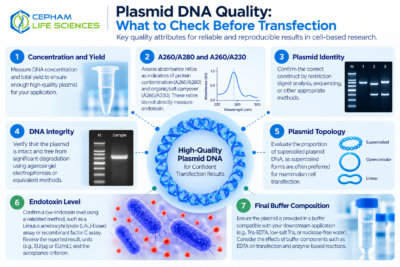
A useful plasmid DNA specification considers multiple attributes rather than relying on a single measurement. Researchers may evaluate:
- DNA concentration and total yield
- A260/A280 and A260/A230 ratios
- Plasmid identity
- DNA integrity
- Plasmid topology or proportion of supercoiled DNA, where relevant
- Endotoxin level
- Final buffer composition
Bacterial endotoxin can be assessed using established bacterial endotoxin test approaches, including Limulus amebocyte lysate (LAL)-based methods and appropriately validated recombinant-reagent methods such as recombinant factor C assays.
The reported endotoxin result is most useful when accompanied by the test method, reporting units, and defined acceptance criterion.
For custom plasmid DNA preparation, requirements should ideally be established before culture begins. Relevant information can include plasmid size, bacterial host and strain, culture scale, target yield, desired DNA concentration, final buffer, endotoxin specification, sterility requirements where applicable to the research workflow, and documentation needs.
Defining these parameters early helps avoid receiving a preparation optimized primarily for yield when the experiment instead requires tighter control of purity, endotoxin, concentration, or formulation.
Practical Handling Considerations
Endotoxin-controlled DNA should be handled carefully after purification to preserve DNA quality and reduce the possibility of introducing contaminants.
Use clean, nuclease-free tubes and water or buffer appropriate for molecular biology applications. Avoid unnecessary repeated freeze-thaw cycles, and consider aliquoting when the same plasmid preparation will support multiple experiments.
Buffer selection also matters. Tris-EDTA can support DNA stability during storage, but EDTA may not be preferred for every downstream application. Some transfection protocols and enzyme-based reactions may be better suited to DNA prepared in low-salt Tris buffer or nuclease-free water. Final formulation should therefore be selected with the intended downstream workflow in mind.
If unexpected cytotoxicity or variable transfection occurs, compare the plasmid preparation with a previously validated DNA control. Also review cell health, passage history, DNA dose, transfection-reagent ratio, serum conditions, and incubation time.
When endotoxin is suspected, comparing an endotoxin-controlled preparation with standard plasmid DNA while keeping the construct, DNA concentration, cell conditions, and delivery parameters constant can help determine whether plasmid purity contributes to the observed result.
Selecting the Right Plasmid Preparation for the Experiment
Routine cloning, restriction analysis, bacterial transformation, and many PCR-related applications may not require the same endotoxin specification as mammalian cell transfection or immune-cell studies.
Using a higher-purity preparation for every application may increase cost and processing requirements without improving the experimental outcome. Conversely, using standard plasmid DNA in a sensitive cell-based assay may introduce an avoidable source of variability.
The appropriate preparation therefore starts with the biological system and experimental readout. Conventional plasmid DNA may be sufficient for routine bacterial and molecular biology workflows. For mammalian expression, sensitive cell-based assays, and experiments in which inflammatory signaling could influence the data, an endotoxin-controlled plasmid preparation is generally a more appropriate starting point.
Cepham Life Sciences supports plasmid DNA preparation and related molecular biology workflows for research applications where defined quality attributes are required.
Before beginning a critical transfection series, document the plasmid preparation specifications alongside the cell-culture and transfection conditions. This makes troubleshooting more efficient and provides a clearer experimental record if results vary between preparations.
References
- QIAGEN. EndoFree Plasmid Purification Handbook. Technical guidance on preparation of endotoxin-controlled plasmid DNA and the influence of bacterial endotoxin on sensitive research applications.
- QIAGEN. Removal of Bacterial Endotoxins. Technical resource discussing bacterial endotoxin contamination, biological effects, and endotoxin removal during plasmid DNA purification.
- U.S. Food and Drug Administration (FDA). Pyrogen and Endotoxins Testing: Questions and Answers. Current guidance addressing bacterial endotoxin testing methods and considerations.
For Research Use Only
Information in this article is intended for research and educational purposes. Plasmid DNA preparation, endotoxin specifications, purification methods, analytical testing, formulation, storage conditions, and downstream applications should be selected according to the experimental system, research objective, laboratory workflow, and applicable reagent or instrument instructions. Research-use plasmid DNA described as low-endotoxin or endotoxin-free is not intended for human administration, therapeutic use, or clinical diagnostic applications unless specifically manufactured, tested, and authorized for those purposes.