

Choosing the Right Genomic DNA Extraction Kit

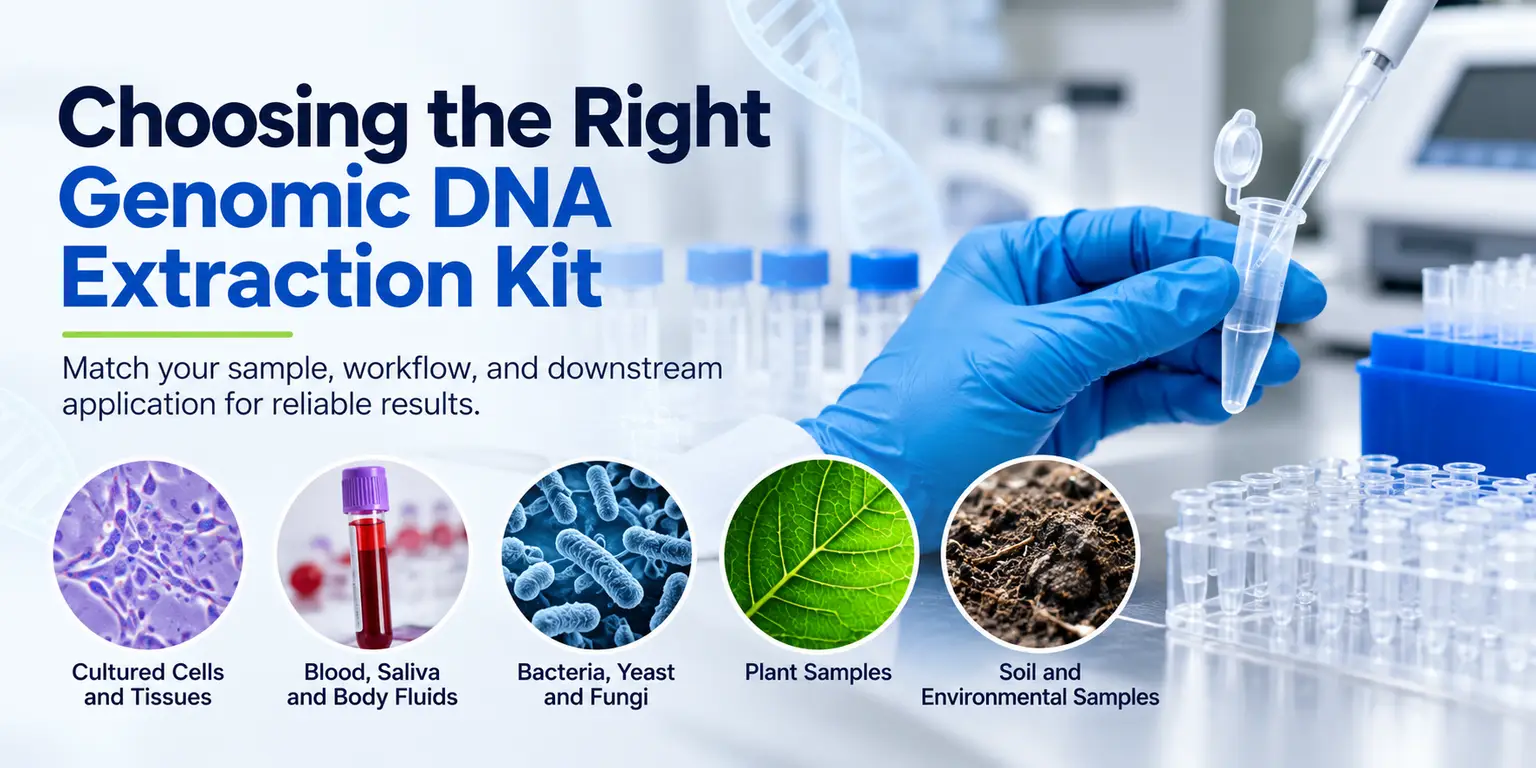
A genomic DNA extraction kit is only as useful as its fit with the sample, downstream assay, and laboratory throughput. A kit that produces clean DNA from cultured mammalian cells may perform poorly with fibrous plant tissue, blood containing PCR inhibitors, or bacterial species with difficult cell walls. Selecting the right workflow at the outset can prevent low yields, fragmented DNA, inconsistent amplification, and unnecessary repeat preparation.
For research laboratories, selection should begin with the biological matrix and end with the intended analytical method. Yield alone is not a sufficient performance measure. Purity, fragment integrity, inhibitor carryover, elution volume, and the ability to process samples consistently all affect whether extracted DNA is suitable for PCR, genotyping, cloning, sequencing, or archival applications.
What a Genomic DNA Extraction Kit Must Accomplish
Genomic DNA isolation generally includes cell lysis, protein removal, nucleic acid capture or precipitation, washing, and elution. Commercial kits package these steps into standardized chemistries, commonly using silica membrane spin columns, magnetic particles, or precipitation-based methods. The preferred format depends on sample number, automation needs, and the sensitivity of downstream analysis.
An effective workflow must lyse the source material without unnecessarily shearing high-molecular-weight DNA. It must also remove contaminants that interfere with enzymatic reactions. Proteins, lipids, polysaccharides, heme, humic substances, detergents, ethanol, and chaotropic salts can compromise PCR efficiency, restriction digestion, library preparation, or sequencing quality.
The practical question is not simply whether DNA can be recovered. It is whether the recovered DNA has the amount, purity, integrity, and consistency required for the next experimental step.
Select a Genomic DNA Extraction Kit by Sample Type
Sample type is the primary selection criterion because lysis requirements and potential contaminants vary substantially between matrices.
Cultured Cells and Soft Tissues
Cultured mammalian cells and many soft tissues are compatible with common detergent- and proteinase K-based lysis workflows. Spin-column kits are often appropriate when processing a modest number of samples and when rapid purification is needed for PCR, qPCR, genotyping, or standard sequencing. For tissue, complete homogenization and adequate proteinase K digestion are important for avoiding reduced yield and variable recovery.
The amount of starting material also matters. Overloading a column can reduce DNA purity and recovery, while very small inputs may require a workflow designed for low cell numbers. Laboratories working with limited biopsies, sorted cells, or laser-captured material should confirm the kit’s recommended input range and expected elution volume before purchasing.
Blood, Saliva, and Other Body-Fluid Research Samples
Whole blood requires chemistry that addresses hemoglobin, anticoagulants, and high protein content. EDTA-anticoagulated blood is commonly compatible with genomic DNA workflows, whereas residual heparin can interfere with PCR if carried through purification. When sample collection conditions cannot be controlled, selecting a method with effective inhibitor removal and including appropriate amplification controls can help identify downstream inhibition.
Saliva and swab samples frequently contain variable quantities of human cells, microbial DNA, mucins, and collection-media components. Yield can vary because of differences in the sample itself as well as extraction efficiency. For these matrices, reproducible performance across low- and high-biomass specimens may be more informative than relying on an average yield specification alone.
Bacteria, Yeast, and Fungi
Microbial cell walls can make routine lysis inadequate. Gram-positive bacteria may require enzymatic pretreatment, such as lysozyme or organism-appropriate lytic enzymes, and some organisms benefit from mechanical disruption. Yeast and fungal samples may require lytic enzymes, bead beating, or extended incubation. A protocol designed only for mammalian cells may leave a substantial fraction of microbial DNA unrecovered.
Mechanical disruption can improve lysis for difficult organisms, but aggressive processing can shorten DNA fragments. This trade-off may be acceptable for many PCR and short-read sequencing applications. It can be problematic when preparing high-molecular-weight DNA for long-read sequencing, optical mapping, or other applications that benefit from intact genomic DNA.
Plant, Soil, and Environmental Samples
Plant and environmental matrices often contain inhibitors that are not fully addressed by standard DNA purification chemistry. Plant tissues may contain polysaccharides and polyphenols, while soil can introduce humic substances and other compounds that inhibit downstream enzymatic reactions.
These contaminants can co-purify with nucleic acids and suppress polymerase activity even when spectrophotometric purity measurements appear acceptable. For challenging matrices, select a genomic DNA extraction kit that includes matrix-specific inhibitor removal or use an appropriately validated supplemental cleanup step.
Additional purification adds time and can reduce total recovery, but obtaining DNA that performs reliably in the downstream assay is generally more important than maximizing yield alone.
Match DNA Quality to the Downstream Application
A useful procurement specification defines the downstream application before comparing kit formats. Standard endpoint PCR may tolerate moderately fragmented DNA, whereas long-range PCR and long-read sequencing require substantially greater fragment integrity. PCR, qPCR, and genotyping workflows can be particularly sensitive to inhibitors. Sequencing library preparation may be affected by both contaminants and inaccurate DNA quantification.
For routine PCR-based research, prioritize clean DNA, reproducible recovery, and a workflow compatible with the expected sample volume. For high-molecular-weight DNA applications, prioritize gentle handling, minimal vortexing after lysis, wide-bore pipette tips where appropriate, and a purification approach designed to minimize unnecessary shear.
Quantification should also fit the application. UV absorbance provides a rapid estimate of nucleic acid concentration and can indicate potential contamination through A260/A280 and A260/A230 ratios. However, absorbance is not specific for double-stranded DNA and can be influenced by other UV-absorbing substances.
Fluorescence-based dsDNA assays are generally more selective for DNA quantification, particularly when concentrations are low or samples contain RNA or residual contaminants. For sequencing and other applications requiring accurate input normalization, the choice of quantification method can be as important as the extraction yield itself.
Spin Columns, Magnetic Beads, or Precipitation?
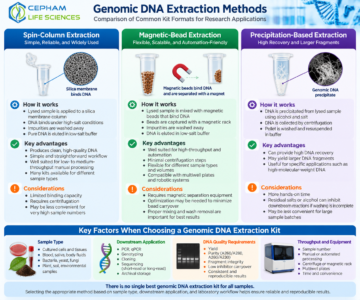
Each purification format has a practical role in molecular biology research.
Spin-Column Extraction
Spin columns are familiar, compact, and well suited to low- or medium-throughput manual processing. They can provide clean DNA with limited hands-on complexity, although binding capacity and centrifuge requirements should be considered. Repeated centrifugation can also become a practical limitation as sample numbers increase.
Magnetic-Bead Extraction
Magnetic-bead workflows are well suited to multiwell plates, automated liquid handling, and scalable processing. They can reduce centrifugation steps and support higher throughput. However, reliable magnetic separation depends on appropriate mixing, complete wash removal, suitable drying conditions where required, and avoidance of excessive bead carryover.
For automated workflows, compatibility should be confirmed at the level of plate type, magnetic-separation hardware, instrument configuration, and liquid-handling parameters.
Precipitation-Based Extraction
Precipitation-based methods may be useful when high recovery or larger DNA fragments are priorities. They can require more manual handling and may be less convenient for large sample batches. Residual salts or alcohol can interfere with downstream enzymatic reactions if washing and drying are incomplete.
The best purification format therefore depends on the combination of sample type, DNA-quality requirement, throughput, available equipment, and downstream application.
Practical Kit Evaluation Before Standardization
Before committing a laboratory workflow to one kit, evaluate representative samples rather than idealized material. Samples should reflect the range of tissue quality, storage conditions, biomass, and expected contaminant burden encountered during routine work.
A small comparison study should assess DNA yield, concentration, purity indicators, fragment integrity, and performance in the actual downstream application. For PCR-based workflows, compare amplification consistency and evidence of inhibition. For sequencing applications, assess library preparation performance and the quality-control metrics relevant to the sequencing platform.
A kit that produces less total DNA but more consistent downstream performance may be the better operational choice.
Reagent format and supply continuity also matter. Review storage conditions, chemical-handling requirements, protocol duration, lot documentation, and packaging sizes. Laboratories operating under controlled procedures may also need to evaluate lot-to-lot consistency, change-control expectations, and whether the protocol can be incorporated into existing documentation and training practices.
Common Extraction Problems and Their Likely Causes
Low DNA yield often begins with incomplete lysis, insufficient homogenization, excessive starting material, overloading of the binding matrix, or inefficient elution. For tissues and microbes, increasing digestion time or adding an appropriate lysis aid may improve recovery when permitted by the protocol.
In some silica-column workflows, applying appropriately warmed elution buffer and allowing a brief incubation before centrifugation can improve DNA recovery. Any modification should remain consistent with the kit manufacturer’s instructions or be validated by the laboratory before routine use.
Low A260/A230 ratios may indicate carryover of salts, chaotropic reagents, carbohydrates, or other contaminants. An additional wash or cleanup step may help if it is compatible with the workflow. Poor PCR performance despite apparently acceptable absorbance ratios can indicate inhibitors that are not readily identified by UV measurements.
Diluting the DNA template can sometimes reduce the concentration of an inhibitor sufficiently to improve amplification, but it simultaneously reduces template concentration. Therefore, dilution should be evaluated alongside appropriate cleanup or re-extraction when inhibition is suspected.
Fragmented DNA can result from aggressive mixing, repeated freeze-thaw cycles, mechanical disruption, extended storage under unsuitable conditions, or harsh purification handling. If fragment length is critical, process fresh or properly stabilized material when possible and use a workflow specifically suited to high-molecular-weight DNA recovery.
Building a Reproducible Research Workflow
The best genomic DNA extraction kit is the one that fits the sample matrix and produces DNA that performs predictably in the laboratory’s next step. Record sample input, lysis conditions, elution volume, DNA concentration method, purity measurements, and downstream performance during method establishment.
Those records make it easier to determine whether a later problem originates in sample quality, extraction, quantification, or the analytical assay.
For research use, a carefully matched extraction workflow provides a practical foundation for reliable molecular results. Start with representative samples, define the quality attributes required by the downstream application, and standardize the method only after the extracted DNA demonstrates consistent performance where it matters most.
References
- Thermo Fisher Scientific — Nucleic Acid Purification and Analysis / DNA & RNA resources
- QIAGEN — QIAamp DNA Mini and Blood Mini Handbook
- PacBio — Library Preparation for Long-Read Sequencing
For Research Use Only
Information in this article is intended for research and educational purposes. Genomic DNA extraction procedures, sample preparation methods, purification conditions, quality-control criteria, and downstream applications should be selected according to the biological sample, research objective, laboratory workflow, and kit manufacturer’s instructions. Researchers should follow applicable institutional biosafety requirements and current instructions for the reagents, instruments, and extraction methods used in their laboratory.