


Microplate Washer Buying Guide for Research Labs

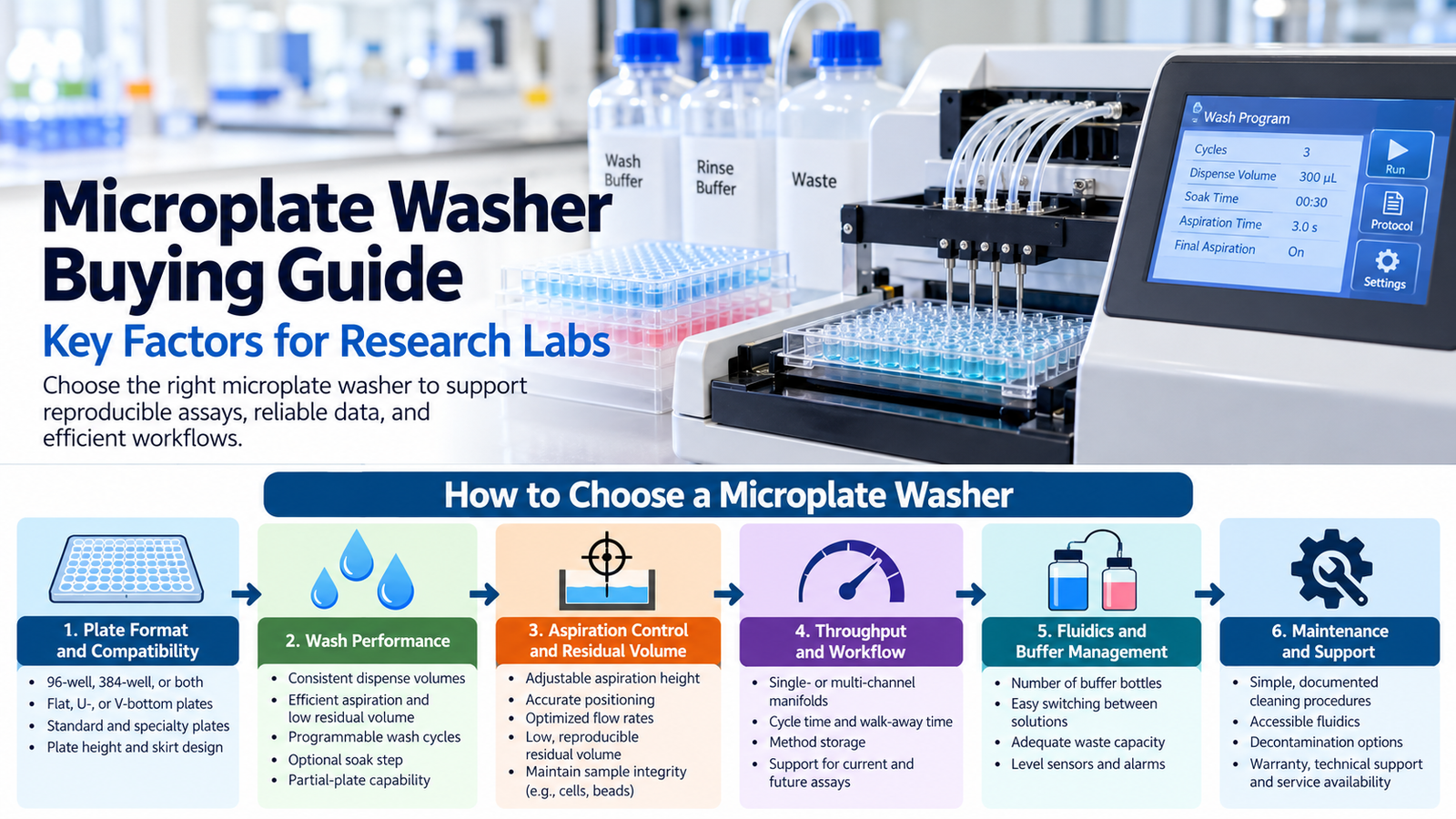
A microplate washer is often treated as a peripheral purchase until inconsistent ELISA backgrounds, variable well-to-well signal, or technician time make its limitations visible. This microplate washer buying guide focuses on the specifications that affect research workflows: plate compatibility, wash precision, throughput, residual volume, fluidics, and the practical demands of routine maintenance.
For protein research, immunoassays, cell-based assays, and related microplate workflows, the right washer should support reproducible removal of unbound reagents without disrupting the material retained in the well. Washing is particularly important in ELISA because insufficient or inconsistent washing can contribute to background and assay variability.
The best choice is rarely the unit with the most features. It is the instrument whose wash modes, plate support, fluidics, and daily operating requirements align with the assays your laboratory runs now and expects to run next.
Start With the Assay and Plate Format
The plate format determines the basic washer configuration. Most laboratories require compatibility with standard 96-well flat-bottom microplates, particularly for ELISA and colorimetric, fluorescent, or chemiluminescent plate assays. However, a washer purchased solely for conventional 96-well ELISA may become restrictive if the laboratory later adopts 384-well assays or specialized cell-based screening formats.
Confirm whether the instrument supports 96-well, 384-well, or both formats without substantial hardware changes. Also verify compatibility with the plate geometries used in your protocols. Flat-bottom, U-bottom, and V-bottom plates can require different aspiration settings because well shape affects where residual liquid collects and how efficiently it can be removed.
Plate height and skirt design matter as well. ANSI/SLAS microplate standards define dimensions such as plate footprint, height, flange geometry, well positions, and well-bottom elevation, but laboratories should still verify compatibility between their specific plates and the washer under consideration.
If your laboratory uses specialty assay plates, confirm physical compatibility with the instrument manufacturer before purchase rather than assuming that every plate of a nominally standard format will perform identically.
Consider the Material Being Washed
An ELISA plate coated with capture antibody, antigen, or another immobilized target tolerates washing differently than a plate containing adherent cells.
ELISA workflows generally benefit from controlled dispensing and efficient aspiration that remove unbound antibody-enzyme conjugates and other assay components. Cell-based workflows require gentler fluid exchange to limit cell detachment, especially during viability studies.
For suspension cells, beads, or loosely attached material, aspiration position and flow characteristics become particularly important. A washer with programmable dispense and aspiration parameters gives the laboratory greater control, but that flexibility is useful only if staff establish and document appropriate settings for each assay.
Evaluate Wash Performance Beyond Cycle Speed
Cycle time is easy to compare, but wash quality often matters more to assay performance.
A suitable washer should deliver consistent buffer volumes across wells, support efficient aspiration, minimize carryover where applicable, and leave a low and reproducible residual volume after aspiration.
Excess residual fluid can dilute subsequent reagents and contribute to assay variability. Overly aggressive aspiration, by contrast, can disturb coated surfaces, cells, beads, or other retained material.
Look closely at the wash-head configuration. Instruments may use single- or multi-channel manifolds with separate dispense and aspiration needles or paired arrangements. Multi-channel heads improve processing speed for full plates, while partial-plate capability can be useful when protocols use only selected rows, columns, or strips.
If your laboratory often runs fewer than 96 samples, determine whether the washer can process only the required portion of the plate without unnecessarily consuming wash buffer.
The number and flexibility of programmable wash steps also matter. Many ELISA procedures require repeated washing, and some protocols incorporate soak periods to improve removal of unbound material.
Ideally, users should be able to program parameters such as wash cycles, dispense volume, aspiration timing or position, soak duration, and final aspiration according to the capabilities of the instrument.
Key Microplate Washer Specifications to Compare
| Specification | Why It Matters | What to Evaluate |
|---|---|---|
| Plate compatibility | Determines which assays can be processed | 96-well, 384-well, plate geometry, plate height, skirt design, and specialty plates |
| Wash manifold | Influences throughput and washing consistency | Number of channels, dispense/aspiration arrangement, and partial-plate capability |
| Residual volume | Remaining liquid may dilute subsequent reagents | Manufacturer specifications and performance with your actual plates and buffers |
| Aspiration control | Affects liquid removal and sample integrity | Aspiration height or position, repeatability, and available flow control |
| Dispense control | Supports consistent washing across wells | Programmable dispense volume and appropriate dispensing characteristics |
| Wash programming | Allows assay-specific methods | Wash cycles, soak steps, aspiration parameters, and final aspiration |
| Method storage | Reduces operator-to-operator variation | Number of stored methods and ease of selecting or protecting protocols |
| Buffer capacity | Important when assays use different wash solutions | Number and size of wash/rinse bottles and ease of switching solutions |
| Waste management | Affects uninterrupted operation and laboratory workflow | Waste capacity, level sensing, and ease of emptying |
| Cleaning and maintenance | Influences long-term consistency | Line rinsing, manifold cleaning, decontamination procedures, and fluidic accessibility |
| Service and support | Determines potential downtime | Warranty, replacement parts, technical support, and service availability |
Residual Volume and Aspiration Accuracy
Residual-volume specifications should be interpreted in context.
A low stated residual volume is desirable, but actual performance can depend on plate geometry, buffer properties, aspiration position, manifold alignment, and instrument condition. Protein-containing solutions, detergents, and other buffer components can also influence fluid behavior.
For this reason, ask the manufacturer or supplier for performance information relevant to plate types and operating conditions similar to your intended workflow rather than comparing a residual-volume number in isolation.
Adjustable or programmable aspiration positioning is particularly useful when working across different plate geometries or with fragile samples. Aspiration needles should remove liquid efficiently without scraping the well bottom or creating unnecessary disturbance.
Repeatable positioning is especially important in laboratories where multiple users operate the instrument.
Choose Automation That Matches Throughput
A basic automated or semi-automated washer can be appropriate for laboratories running a limited number of plates per week. Simpler systems may have a smaller footprint and lower acquisition cost while requiring more hands-on plate loading or method selection.
For laboratories with occasional ELISA work, simplicity can be an advantage.
Higher-throughput settings may benefit from features such as automated plate handling, stacking, barcode capability, or integration with readers and liquid-handling systems. These capabilities can reduce handling steps and support consistent batch processing, but they also increase acquisition cost, space requirements, setup complexity, and service needs.
Before selecting a high-throughput platform, calculate realistic rather than theoretical throughput.
Include time for:
- Reagent and wash-buffer preparation
- Plate setup and loading
- Incubation
- Method changes
- Buffer replenishment
- Waste disposal
- Cleaning
- Plate reading
- Documentation
A washer capable of processing many plates per hour provides limited benefit if incubation, liquid handling, or downstream plate reading remains the workflow bottleneck.
For many research laboratories, method storage may be more valuable than advanced robotic automation. Saved protocols reduce setup variation when different users perform recurring assays such as cytokine ELISAs or antibody-screening workflows.
Confirm how many methods the instrument stores, how users identify them, and whether important settings can be protected from accidental modification.
Review Fluidics, Bottles, and Contamination Control
The fluidic path deserves as much attention as the user interface.
Determine how many wash or rinse bottles the instrument supports and whether switching between solutions is automated or manual. Multiple-buffer capability can be useful when different assays require different wash solutions.
For laboratories using one standard wash buffer, however, additional bottle positions may provide little practical benefit.
Waste handling should be evaluated for capacity, level sensing, and ease of emptying. An undersized waste container can interrupt a long run, while poorly arranged waste connections can complicate routine operation.
If the instrument will be placed in a shared laboratory, also consider bottle access, tubing arrangement, footprint, noise, and the practical bench space required for operation and maintenance.
Carryover control becomes particularly relevant when the same washer supports multiple assay systems. Review the manufacturer’s recommended rinsing or decontamination procedure between buffers and projects.
Tubing, manifolds, reservoirs, and other fluid-contact components should be accessible enough for routine cleaning and inspection.
Build Maintenance Into the Purchase Decision
Microplate washers are fluidic instruments, and consistent operation depends on routine care.
Wash-buffer salts can crystallize, residues can accumulate, and microbial growth may occur in bottles or tubing when solutions are stored or handled improperly. Clogged dispense or aspiration needles can produce uneven washing that may initially appear to be an assay problem rather than an instrument problem.
Ask what daily, weekly, and periodic maintenance the manufacturer requires.
Depending on the instrument, typical tasks may include:
- Flushing or rinsing fluid lines with manufacturer-recommended solutions
- Cleaning the wash manifold
- Inspecting tubing, seals, and connections
- Emptying and cleaning waste containers
- Preventing salt deposits or blockages
- Performing manufacturer-specified decontamination procedures
The exact procedure depends on the instrument and the solutions being used. Laboratories should incorporate the manufacturer’s approved maintenance instructions into their standard operating procedures rather than applying a generic cleaning protocol.
Service access is also a practical procurement consideration. Review warranty coverage, availability of replacement manifolds and tubing, expected service response time, preventive-maintenance options, and whether trained laboratory personnel can perform routine corrective procedures.
A lower initial purchase price may not offset prolonged downtime if the washer supports a high-volume or time-sensitive assay workflow.
Consider Total Cost of Ownership
Purchase price is only one part of the cost of a microplate washer.
Before making a final decision, consider expenses associated with:
- Replacement manifolds or wash heads
- Tubing and other fluidic components
- Wash and waste bottles
- Preventive maintenance
- Service contracts
- Installation or training
- Specialized consumables
- Software or automation integration, where applicable
- Instrument downtime
For a low-throughput laboratory, a simpler washer with reliable service may provide better long-term value than a highly automated system whose advanced capabilities are rarely used.
Conversely, laboratories processing large numbers of plates may find that automation and higher capacity justify a higher initial investment by reducing hands-on time and improving workflow consistency.
Questions to Ask Before Final Selection
Use the following questions to compare instruments based on workflow fit rather than headline specifications:
- Which plate formats, well geometries, plate heights, and specialty plates must the washer support?
- Does the instrument support both current assays and likely future applications?
- Can it process partial plates or selected strips, rows, or columns?
- Are dispense volume, aspiration position, soak time, and wash cycles programmable?
- What residual volume and well-to-well consistency can be expected with your actual plate type and wash buffer?
- Can assay-specific methods be stored and easily recalled?
- How are wash-buffer switching, rinsing, waste management, and fluid-line cleaning handled?
- What routine maintenance is required?
- Which consumables and replacement parts are proprietary?
- What training and technical support are provided?
- How quickly is service available if the instrument fails?
- What is the expected total cost of ownership over several years?
Final Considerations
A well-selected microplate washer supports one of the most easily underestimated steps in a microplate assay: repeatable removal of material that should not remain in the well.
For ELISA and related workflows, washing quality can directly influence background and reproducibility, making consistent aspiration and dispensing more important than simply choosing the fastest instrument.
Review your actual plate types, assay chemistry, throughput, fluid-handling requirements, maintenance capacity, and future workflow needs before purchasing.
The best microplate washer is not necessarily the most automated or expensive model. It is the instrument that makes reproducible washing easier to achieve and sustain in your laboratory.
References
- Society for Laboratory Automation and Screening (SLAS). ANSI/SLAS Microplate Standards. Standards covering microplate footprint dimensions, height dimensions, bottom outside flange dimensions, well positions, and well-bottom elevation.
- Thermo Fisher Scientific. ELISA Troubleshooting Guide. Guidance on ELISA washing, residual liquid, aspiration, soak steps, and troubleshooting inconsistent assay results.
- Thermo Fisher Scientific. ELISA Instrumentation and Equipment. Information on microplate washers and 96- and 384-well ELISA workflows.
- Thermo Fisher Scientific. Basic Sandwich ELISA Protocol. Practical guidance on aspiration and repeated microplate washing during ELISA workflows.
- Thermo Fisher Scientific. Wellwash Microplate Washer User Manual. Technical information on microplate washer configuration, plate compatibility, and operation.
For Research Use Only
Information in this article is intended for research and educational purposes. Instrument specifications, compatible plate formats, cleaning procedures, and operating requirements vary by manufacturer and model. Always consult the instrument manufacturer’s current instructions and validated laboratory procedures before use.