


RNA Integrity Assessment Methods for Research

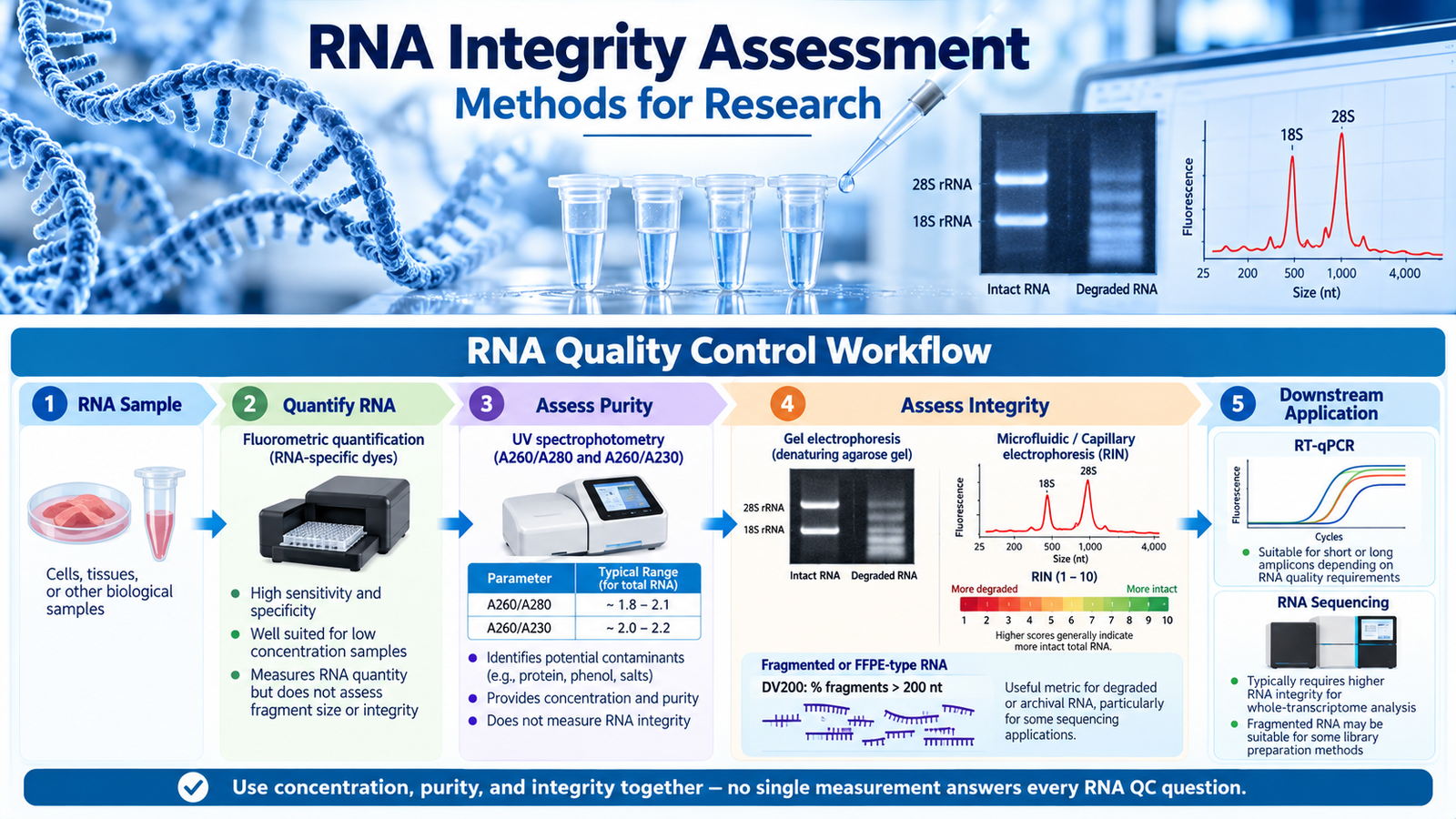
RNA integrity assessment methods help determine whether an RNA preparation is suitable for the experiment that follows. This evaluation is more than a routine quality-control step. Partially degraded RNA can alter transcript representation, reduce amplification performance, complicate normalization, and introduce apparent biological differences that are actually caused by sample handling or degradation.
The appropriate RNA quality-control strategy depends on the sample type, downstream application, available sample quantity, and the level of confidence required before committing valuable material to RT-qPCR, RNA sequencing, or other molecular biology workflows.
Why RNA Integrity Matters Before Downstream Analysis
RNA is particularly susceptible to degradation by endogenous and environmental RNases. Delayed tissue stabilization, repeated freeze-thaw cycles, inappropriate storage conditions, and suboptimal extraction procedures can further compromise RNA quality. In some tissues with high endogenous RNase activity, degradation can begin before RNA isolation is initiated.
For many applications, RNA concentration and purity measurements alone are not sufficient to establish sample quality. An RNA preparation can have an acceptable concentration and A260/A280 ratio while still containing extensively fragmented RNA.
This distinction is important:
- Concentration indicates how much RNA is present.
- Purity helps identify contamination by proteins, phenol, salts, and other substances.
- Integrity evaluates the physical condition and fragmentation of the RNA population.
These measurements provide complementary information and should be considered together when RNA quality could influence experimental interpretation.
High-integrity RNA is particularly important for whole-transcriptome RNA sequencing, long-amplicon RT-qPCR, full-length cDNA synthesis, and experiments designed to detect relatively subtle differences in gene expression. Other workflows, particularly those designed around short amplicons or fragmented RNA, may tolerate lower RNA integrity.
For this reason, acceptable RNA quality should be defined according to the requirements of the downstream application rather than by applying a single universal threshold.
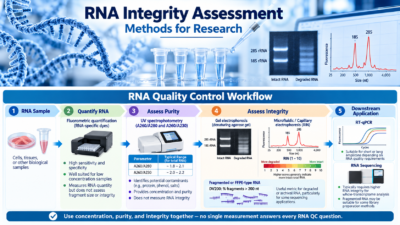
Figure 1. RNA quality-control workflow illustrating complementary approaches for assessing RNA concentration, purity, and integrity before downstream applications.
Core RNA Integrity Assessment Methods
Denaturing Agarose Gel Electrophoresis
Denaturing agarose gel electrophoresis is a traditional visual method for evaluating total RNA integrity. Under appropriate denaturing conditions, intact eukaryotic total RNA typically displays prominent ribosomal RNA bands corresponding to 28S and 18S rRNA. Progressive smearing toward lower molecular weights generally indicates increasing RNA fragmentation.
Gel electrophoresis provides a relatively inexpensive way to identify gross degradation and may also reveal high-molecular-weight genomic DNA contamination or sample-loading problems.
However, interpretation is partly subjective, low-concentration samples may be difficult to evaluate, and conventional gels generally require more sample than many automated electrophoretic methods. For studies requiring standardized acceptance criteria across many samples, automated electrophoresis can provide more objective and reproducible assessment.
Microfluidic and Capillary Electrophoresis
Automated microfluidic and capillary electrophoresis systems separate RNA fragments according to size and can generate electropherograms, virtual gel images, and numerical RNA-quality metrics.
One widely used metric is the RNA Integrity Number (RIN). Other platforms may report related metrics, such as RQN or RIN equivalent (RINᵉ). These systems evaluate multiple characteristics of the RNA electrophoretic profile rather than relying solely on the 28S:18S rRNA ratio. Agilent, for example, reports its RNA integrity metrics on a scale from 1 to 10, with higher values indicating higher-quality total RNA.
For many conventional eukaryotic total-RNA applications, researchers often use higher RIN values as evidence of better-preserved RNA. However, a specific RIN cutoff should not be treated as a universal pass/fail criterion. Appropriate acceptance limits depend on the specimen, assay, experimental design, and downstream workflow.
Automated electrophoresis is particularly useful for qualifying samples before RNA sequencing, comparing extraction methods, evaluating batch consistency, and documenting RNA quality across larger studies.
Spectrophotometric Purity Analysis
UV spectrophotometry is commonly used to estimate nucleic acid concentration and evaluate sample purity through absorbance ratios such as A260/A280 and A260/A230.
For relatively pure RNA, an A260/A280 ratio near 2.0 is commonly expected. A260/A230 values around 2.0–2.2 are also frequently associated with relatively clean nucleic acid preparations. However, these ratios can be influenced by RNA concentration, buffer composition, blanking solution, extraction chemistry, and instrument performance.
Importantly, spectrophotometry does not directly measure RNA integrity.
An extensively fragmented RNA preparation may still produce apparently acceptable absorbance ratios. Spectrophotometric measurements are therefore most useful for assessing concentration and potential contamination rather than as a replacement for direct RNA integrity analysis.
Fluorometric RNA Quantification
Fluorometric assays use RNA-selective fluorescent dyes to quantify RNA and can provide greater sensitivity and specificity than absorbance measurements, particularly at low RNA concentrations.
This approach can be especially useful when DNA, free nucleotides, phenol, or other UV-absorbing substances could interfere with spectrophotometric measurements.
Fluorometry provides information about RNA quantity, however, not fragment-size distribution or RNA integrity. It is therefore often used together with electrophoretic analysis when accurate input normalization and integrity assessment are both important.
RT-qPCR-Based Functional Assessment
RT-qPCR can provide a functional assessment of RNA quality by examining how effectively an RNA preparation supports reverse transcription and amplification.
One strategy is to compare amplification of relatively short and long amplicons. Because fragmented RNA may retain short target regions while losing longer continuous templates, degradation can disproportionately affect amplification of longer targets. Other approaches compare different regions of the same transcript.
RT-qPCR-based assessment can be particularly useful when RT-qPCR itself is the downstream application or when researchers need to determine whether specific transcripts remain suitable for analysis.
However, RT-qPCR should not generally be considered a universal replacement for electrophoretic RNA profiling because results depend on primer design, transcript abundance, reverse-transcription conditions, and the genes being evaluated. The current MIQE 2.0 guidelines also emphasize appropriate sample handling, assay validation, and transparent reporting for reliable qPCR experiments.
Selecting an RNA Integrity Method by Sample and Application
No single measurement answers every RNA quality-control question. A practical workflow generally combines information about concentration, purity, and integrity.
For routine RT-qPCR using short amplicons, accurate quantification and purity measurements may sometimes be sufficient when extraction procedures are well controlled and RNA integrity has been established for representative samples.
For whole-transcriptome RNA sequencing, microarray studies, long-amplicon applications, or biobanked samples with uncertain handling histories, direct electrophoretic assessment of RNA integrity can provide important additional information.
RNA source also affects interpretation. Conventional eukaryotic total RNA generates characteristic ribosomal RNA patterns, whereas bacterial RNA, plant RNA, and specialized sample types may produce different electrophoretic profiles or require platform-specific evaluation.
Degraded and FFPE RNA: When DV200 May Be More Informative
RNA extracted from formalin-fixed, paraffin-embedded (FFPE) tissue presents a special challenge because fragmentation is often inherent to the specimen and processing method.
For these samples, a low RIN does not necessarily mean that the RNA is unsuitable for every downstream application.
The DV200 metric describes the percentage of RNA fragments longer than 200 nucleotides. For degraded FFPE RNA, DV200 can provide information that RIN alone may not capture and is used by some sequencing workflows to guide sample qualification and input requirements. Illumina specifically describes DV200 as useful for FFPE RNA because samples with similarly low RIN values can nevertheless have substantially different fragment-size distributions.
This illustrates an important principle in RNA quality control: sample quality should be evaluated in the context of the intended experiment.
A degraded sample may still be useful when the downstream method has been designed for fragmented RNA. Conversely, a favorable integrity score does not guarantee successful results if the sample contains inhibitors, genomic DNA contamination, or other problems.
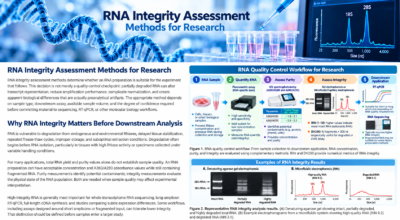
Figure 2. Representative approaches for evaluating RNA integrity using electrophoretic profiles and numerical quality metrics.
Building an RNA Quality-Control Workflow
An effective RNA QC workflow begins before RNA extraction.
Use RNase-free tubes, pipette tips, water, and reagents. Minimize unnecessary sample handling, maintain appropriate temperatures, and stabilize tissues promptly when required by the experimental protocol.
During RNA isolation, follow chemistry-specific recommendations for sample lysis, homogenization, washing, and elution. Incomplete disruption may reduce RNA recovery, while inappropriate or prolonged handling can increase the opportunity for degradation.
After isolation, a practical workflow may include:
- Quantify the RNA using an appropriate fluorometric or spectrophotometric method.
- Evaluate purity using absorbance ratios when relevant.
- Assess integrity using gel electrophoresis or automated electrophoretic analysis when required by the downstream application.
- Document sample history, including extraction batch, concentration, purity, integrity metric, storage conditions, and freeze-thaw history.
- Apply predefined acceptance criteria appropriate for the intended experiment.
When poor RNA integrity is detected, troubleshooting should focus upstream rather than simply repeating the same measurement. Review collection-to-stabilization time, RNase control, homogenization efficiency, storage temperature, freeze-thaw history, and compatibility of the extraction procedure with the sample type.
If recollection is impossible, researchers may need to select a downstream method specifically designed to accommodate fragmented RNA and document the limitation in the experimental design.
Interpreting RNA Quality Without Over-relying on a Single Score
Numerical integrity metrics are valuable because they support objective and consistent sample comparisons, but they should not replace scientific context.
Two samples with similar integrity scores may perform differently because of inhibitors, differences in RNA composition, or degradation patterns not completely represented by a single metric. Likewise, moderately degraded RNA may still generate useful data when the experimental method uses short targets or is specifically designed for fragmented material.
Acceptance criteria should therefore be established around the intended application and applied consistently across experimental groups.
Researchers should also consider whether RNA quality differs systematically between experimental groups. If one group consistently contains more degraded RNA than another, sample quality itself can become a source of experimental bias.
A thoughtful RNA quality-control strategy protects both valuable samples and the conclusions derived from them. The most appropriate approach is generally one that combines sufficient information about RNA concentration, purity, and integrity while preserving enough material for the downstream experiment.
Supporting RNA and Molecular Biology Research
Cepham Life Sciences provides research products supporting molecular biology and nucleic acid workflows, including biological buffers and reagents, PCR and nucleic acid research products, molecular biology reagents, laboratory supplies, and related research applications.
For Research Use Only.
References
- Bustin SA, Ruijter JM, van den Hoff MJB, et al. MIQE 2.0: Revision of the Minimum Information for Publication of Quantitative Real-Time PCR Experiments Guidelines. Clinical Chemistry. 2025;71(6):634–651. doi:10.1093/clinchem/hvaf043.
- Schroeder A, Mueller O, Stocker S, et al. The RIN: an RNA integrity number for assigning integrity values to RNA measurements. BMC Molecular Biology. 2006;7:3. doi:10.1186/1471-2199-7-3.
- Agilent Technologies. RNA Analysis: Qualified RNA for Quality Results. Automated electrophoresis systems provide RIN, RQN, and RINᵉ metrics for objective total-RNA quality assessment.
- Illumina. Evaluating RNA Quality from FFPE Samples. Technical Note. DV200 measures the percentage of RNA fragments greater than 200 nucleotides and can provide useful qualification of degraded FFPE RNA for applicable sequencing workflows.