


Loading Control Antibody Selection for Western Blots

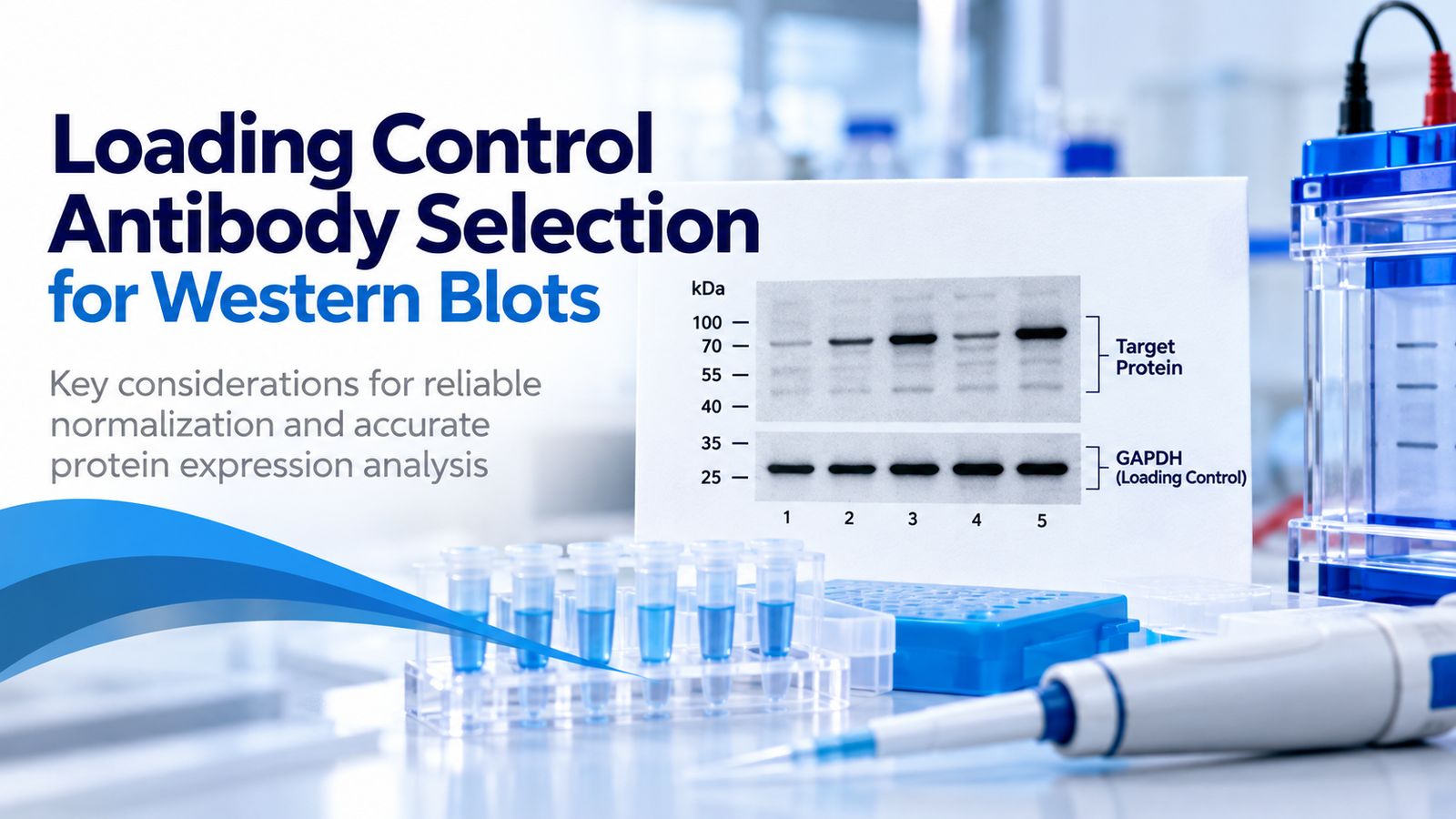
A loading control can make a clean Western blot interpretable or quietly compromise an otherwise well-executed experiment. Loading control antibody selection should not simply involve choosing the most familiar housekeeping protein. The selected control should remain stable under the experimental conditions, resolve clearly from the target protein, and produce a signal within the linear range of the detection method.
For researchers generating comparative protein-expression data, the loading control is an important part of the measurement system. It can help account for differences in protein loading and support normalization between samples. However, if the expression of the selected control changes with treatment, cell state, tissue type, or experimental conditions, normalization may introduce bias rather than correct it.
Start With the Experimental Question
The appropriate loading control depends on what is being compared. A control suitable for untreated adherent cell lines may be unsuitable for hypoxic cells, differentiating cultures, tissue samples, or cells exposed to cytotoxic compounds. Experimental conditions can alter cytoskeletal proteins, metabolic enzymes, and other proteins that are often assumed to be constitutively expressed.
Before selecting an antibody, define the sample source, target protein molecular weight, treatment conditions, lysis method, and detection system. These variables help determine whether a conventional housekeeping protein is appropriate or whether a total-protein normalization approach should be considered.
For example, beta-actin is frequently used because it is abundant and readily detected in many cell lysates. However, high abundance can become a limitation when chemiluminescent detection produces saturated control bands. Actin expression may also vary under experimental conditions involving cytoskeletal remodeling, cell migration, differentiation, or other changes in cell state. A familiar loading control should therefore still be treated as an experimental variable requiring validation.
Key Criteria for Loading Control Antibody Selection
Match the Control to Target Molecular Weight
Molecular-weight separation is an important practical consideration. The loading-control band should be sufficiently separated from the target band to permit clear interpretation, particularly when both proteins are detected on the same membrane.
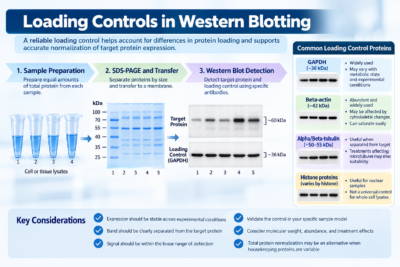
Common loading controls occupy different molecular-weight ranges:
| Loading Control | Approximate Molecular Weight | Important Considerations |
|---|---|---|
| GAPDH | ~36 kDa | Commonly used, but expression may vary with metabolic state and experimental conditions |
| Beta-actin | ~42 kDa | Abundant and widely used; may be affected by cytoskeletal changes and can saturate easily |
| Alpha/Beta-tubulin | ~50–55 kDa | Useful when sufficiently separated from the target; treatments affecting microtubules may alter suitability |
| Histone proteins | Varies by histone | Useful primarily for nuclear samples; not a universal control for whole-cell lysates |
These approximate molecular weights should be considered together with the expected migration characteristics of the specific sample and antibody.
If the protein of interest migrates close to the selected loading control, consider using a control at a different molecular weight, analyzing separate membrane sections, or detecting the target and control under separate conditions. Reprobing can be useful, but stripping may reduce signal quality and introduce additional variability.
Multiplex fluorescent Western blotting expands the available detection options because different targets can be distinguished using separate fluorescence channels. However, fluorophore separation does not eliminate all problems associated with strongly overlapping bands. Appropriate molecular-weight separation remains valuable.
Confirm Biological Stability in the Sample Model
A loading control is useful for normalization only when its expression is sufficiently stable across the samples and experimental groups being compared. This should be verified rather than assumed.
Evaluate candidate controls across biological replicates and all major experimental conditions. Determine whether the loading-control signal changes systematically with treatment, cell type, tissue type, disease model, differentiation state, or other relevant biological variables.
Common housekeeping proteins can be affected by experimental context. GAPDH, for example, is involved in cellular metabolism and may not remain stable under every metabolic or stress condition. Tubulin may be unsuitable for experiments involving microtubule dynamics, while actin requires particular caution when cytoskeletal regulation is part of the biological response.
Histone proteins may be useful controls for nuclear extracts, but they are not automatically appropriate for whole-cell lysates or fractionation experiments in which compartment purity must also be demonstrated.
The appropriate loading control is therefore context-dependent. A less commonly used protein that has been experimentally shown to remain stable in the study model may be preferable to a familiar housekeeping protein that changes with the intervention.
Consider Abundance and Detection Range
Loading controls are often abundant proteins, but abundance must be managed carefully. Highly expressed proteins can produce saturated signals, particularly with extended chemiluminescent exposures.
A saturated band is unsuitable for reliable quantitative normalization because signal intensity is no longer proportional to the amount of protein present.
Optimize protein loading, primary antibody dilution, secondary antibody concentration, and exposure conditions so that both target and loading-control signals remain within their respective linear detection ranges.
If a low-abundance target requires a long exposure while the loading control becomes saturated, capture separate exposures or use an imaging method with an appropriate quantitative dynamic range. A visually strong loading-control band is not necessarily a quantitatively useful one.
Verify Species Reactivity and Antibody Compatibility
Select an antibody validated for the species represented by the sample and for Western blotting. Reactivity reported for another application, such as immunocytochemistry or ELISA, does not by itself establish Western blot performance.
The host species of the primary antibodies also matters when conventional secondary-antibody detection is used. If the target and loading-control primary antibodies are raised in the same host species, separate probing strategies, directly conjugated antibodies, or other detection approaches may be necessary.
Multiplex workflows require additional consideration of fluorophore channels, secondary-antibody specificity, cross-reactivity, and spectral overlap.
For tissue homogenates, organoids, primary cells, or less commonly studied organisms, application-specific validation and documentation are particularly important. Detection of a band at the expected molecular weight supports antibody specificity, but the result should be interpreted together with appropriate positive and negative controls and knowledge of the biological sample.
When Total Protein Normalization Is the Better Option
Total-protein normalization measures the aggregate protein signal in each lane rather than relying on the abundance of a single endogenous housekeeping protein.
Approaches such as stain-free detection and suitable total-protein stains can provide useful alternatives when commonly used housekeeping proteins are expected to vary with the experimental conditions. Published studies have shown advantages of total-protein normalization in a number of Western blot workflows, although the suitability and performance of individual methods should still be validated for the experimental system.
Total-protein normalization may be particularly useful for experiments involving broad changes in metabolism, cell structure, proliferation, differentiation, or viability, as well as samples with heterogeneous cellular composition.
However, total-protein normalization is not automatically proof of accurate quantitation. Lane signals must remain within the measurable range, staining or detection should be sufficiently uniform, and high-background or poorly transferred samples should be investigated.
Total-protein normalization also does not replace controls for subcellular fractionation. For nuclear, cytoplasmic, mitochondrial, or membrane-enriched preparations, appropriate compartment-specific markers remain important for assessing enrichment and cross-contamination.
A practical workflow may therefore use total-protein normalization for quantitative comparison while using compartment-specific proteins as quality-control markers. The appropriate strategy depends on the experimental design and the biological conclusion being tested.
Validate Before Committing to a Study
Loading-control validation should ideally occur before a large experiment consumes valuable samples and reagents.
Begin with a pilot experiment that includes the anticipated experimental conditions rather than only untreated or control samples. A dilution series of representative lysate can help establish the linear detection range for both the target and candidate loading control.
Confirm that the selected loading-control signal is:
- Clearly separated from the target when necessary
- Within the linear detection range
- Free from significant saturation
- Reproducible across technical conditions
- Sufficiently stable across the biological groups being compared
Review the data quantitatively rather than relying only on visual similarity. Densitometric analysis can reveal systematic differences that are difficult to recognize by eye. If a candidate loading control changes with the experimental intervention, normalization to that protein can mask a true biological effect or create an apparent difference that does not accurately represent the target.
Document the antibody clone or catalog specification, lot number when relevant, working dilution, blocking reagent, protein load, transfer conditions, imaging platform, and exposure parameters. Consistent documentation improves reproducibility between experiments and makes troubleshooting more efficient.
Common Selection Errors That Affect Data Quality
One of the most common errors is assuming that a loading control is invariant simply because it is widely used. Published use provides useful background information, but it does not substitute for validation in a new sample type or experimental treatment.
Another common problem is selecting a loading control with a molecular weight too close to the target and then attempting to interpret partially overlapping signals as independent bands.
Excessive protein loading can also undermine normalization. Strong bands may appear reassuring, but saturation reduces their quantitative value. Conversely, a very weak loading-control signal can increase the contribution of background noise and variability.
Loading controls should also not be used to compensate for poor sample quality. A consistent housekeeping-protein band does not demonstrate that all lysates have comparable integrity, nor does a single control protein verify transfer performance across the entire molecular-weight range.
Accurate protein quantitation before loading, appropriate sample preparation and storage, careful electrophoresis, and verification of protein transfer remain important components of Western blot quality control.
Build Loading Control Selection Into the Western Blot Workflow
Effective loading control antibody selection begins during experimental planning rather than after target bands have already been generated.
Choose candidate controls based on the biological model, expected molecular weight, treatment conditions, antibody validation, and detection method. Evaluate candidate controls under the actual experimental conditions and retain the validation information with the study data.
For routine Western blotting, a validated loading control can improve consistency between experiments. For quantitative or publication-oriented studies, careful normalization is particularly important because the choice of control directly affects interpretation of relative protein-expression data.
Cepham Life Sciences provides research products supporting protein analysis workflows, including antibodies, protein extraction reagents, biological buffers, protein quantitation products, electrophoresis reagents, and Western blotting research applications.
For Research Use Only.
References
- Wang Q, Han W, Ma C, et al. Western blot normalization: Time to choose a proper loading control seriously. Electrophoresis. 2023;44(9-10):854-863. doi:10.1002/elps.202200222.
- Moritz CP. Tubulin or Not Tubulin: Heading Toward Total Protein Staining as Loading Control in Western Blots. Proteomics. 2017;17(20):1600189. doi:10.1002/pmic.201600189.
- Thacker JS, Yeung DH, Staines WR, Mielke JG. Total protein or high-abundance protein: Which offers the best loading control for Western blotting? Anal Biochem. 2016;496:76-78. doi:10.1016/j.ab.2015.11.022.
- Neris RLS, Dobles AMC, Gomes AV. Western Blotting Using In-Gel Protein Labeling as a Normalization Control: Advantages of Stain-Free Technology. Methods Mol Biol. 2021;2261:443-456. doi:10.1007/978-1-0716-1186-9_28.