


Custom Reagent Manufacturing Services for Research

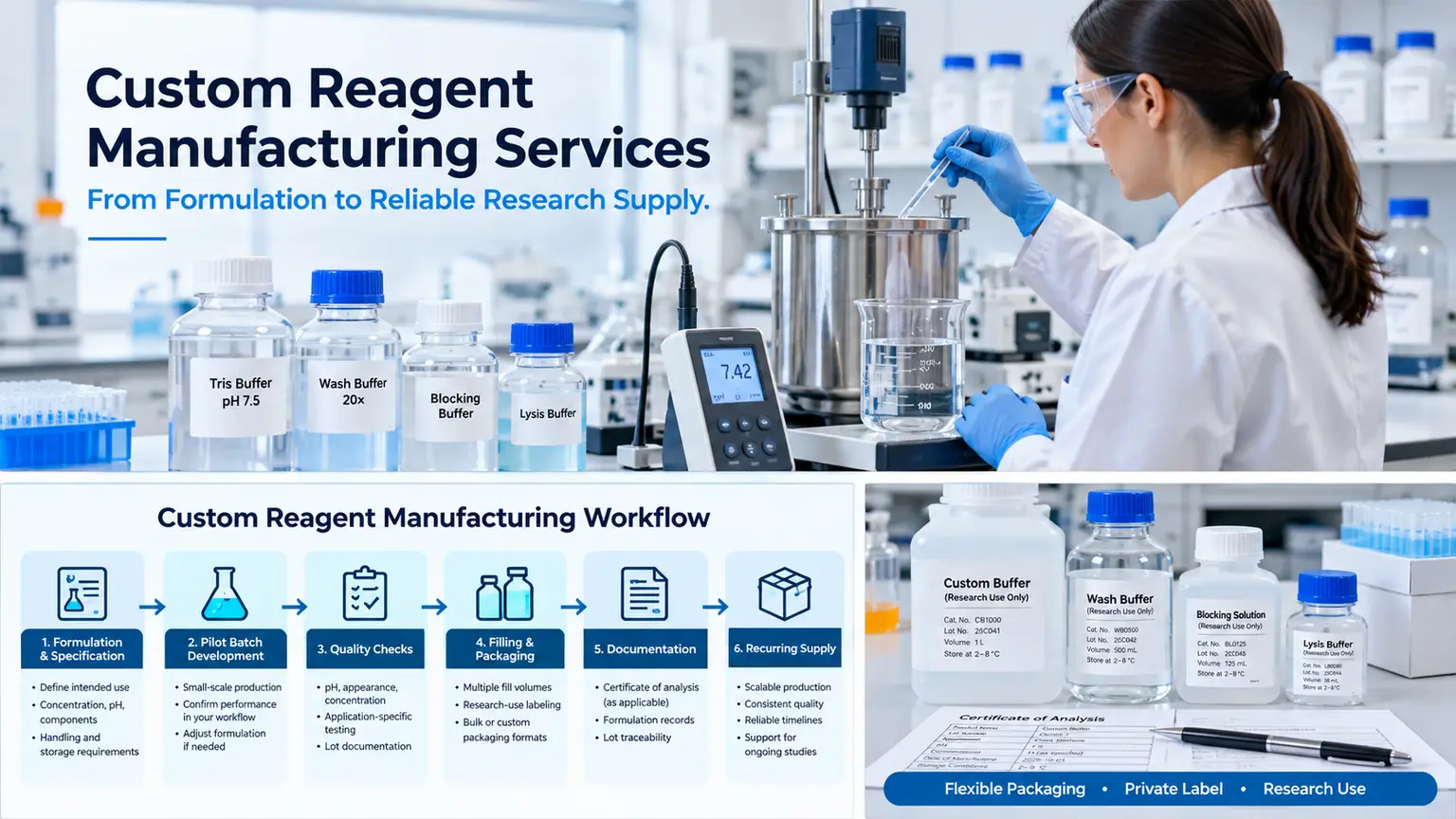
A buffer that works during early method development can become a supply-chain problem once multiple teams, sites, or studies depend on it. Changes in lot availability, package size, documentation, or preparation time can introduce avoidable variability into protein extraction, electrophoresis, immunoassays, cell-based work, and nucleic acid workflows.
Custom reagent manufacturing services can help research laboratories establish a defined product specification and a repeatable path from development-scale material to ongoing supply.
For research-use workflows, customization is not simply a matter of placing a preferred formulation into a different bottle. The useful outcome is a reagent matched to its intended application, handling conditions, quality requirements, packaging, and purchasing model. That requires clear communication between the laboratory and manufacturer before production begins.
When Custom Reagent Manufacturing Services Are Appropriate
Custom manufacturing is most useful when a laboratory has a formulation or workflow requirement that standard catalog products do not fully address.
Common examples include a proprietary lysis buffer, a wash buffer with defined detergent content, a blocking solution compatible with a particular assay, or a specialized buffer supplied at a concentration that reduces preparation steps at the bench.
It may also be appropriate when researchers need consistent supply of a formulation used across a program, want a private-label research product for distribution, or need a laboratory reagent packaged for a particular workflow.
A custom product can reduce the need for internal weighing, pH adjustment, filtration, aliquoting, and labeling. For teams running repeated Western blots, ELISAs, protein purification experiments, or cell viability assays, reducing repetitive preparation steps may also improve day-to-day workflow consistency.
The decision depends on volume and complexity. A catalog reagent is often the better choice for a small, infrequent study with conventional requirements. Custom manufacturing becomes more compelling when the same preparation is repeatedly made in-house, when its composition is central to the method, or when sourcing individual components creates unnecessary operational risk.
Define the Reagent Before Requesting a Quote
A productive custom project starts with a usable specification.
Researchers should identify the reagent’s intended use, target formulation, concentration, pH range, solvent system, and preferred fill volume. Details that appear minor can matter during manufacturing.
For example, the choice between Tris base and Tris-HCl, the grade of salt, concentration of EDTA, detergent type, or presence of a preservative may affect compatibility with downstream protein assays, antibody binding, enzyme activity, or cell-based applications.
A good request should also describe practical handling requirements:
- Intended research application
- Target formulation and concentration
- Required pH or acceptable pH range
- Preferred raw-material grades, where important
- Fill volume and package size
- Storage temperature
- Light-protection requirements
- Sterile filtration, if required
- Concentrate or ready-to-use format
- Expected storage period
- Anticipated order volume and frequency
If a formulation contains components with limited stability, researchers should also consider whether the material will undergo repeated opening or freeze-thaw cycles.
Define Appropriate Quality Checks
Analytical expectations should be specified early.
Depending on the reagent and application, appropriate quality checks may include pH, appearance, conductivity, osmolality, concentration testing, application-specific testing, or other agreed specifications.
Not every test is meaningful for every buffer or reagent. Requiring unnecessary testing can increase cost and lead time, while omitting a critical check can make the material unsuitable for its intended workflow.
The objective should therefore be to establish quality checks that are scientifically relevant to the formulation and its research application.
Application Compatibility Matters
Custom reagents should be evaluated in the context of the complete experimental system.
A lysis buffer for Western blot sample preparation may need to preserve protein solubility while remaining compatible with protein quantitation and electrophoresis. A buffer used for affinity purification may require defined ionic strength and pH to support target binding without interfering with elution or downstream analysis.
For immunoassays, detergent concentration, protein blockers, preservatives, and buffer salts can influence background signal and antibody performance.
For molecular biology applications, nuclease control and the presence of potential PCR inhibitors may be more relevant than pH alone. Cell culture and cell-based assay reagents require additional consideration of sterility, osmolality, component suitability, and potential effects on cell health.
This is why providing the intended workflow can be as valuable as providing the formula. The manufacturer can review whether the requested materials, production approach, and packaging are appropriate for the intended research application.
Final performance confirmation should still occur in the customer’s assay, particularly when the formulation supports a proprietary or highly sensitive method.
From Formulation Review to Pilot Production
The manufacturing process typically begins with a technical review of the requested formulation and deliverables.
This stage may identify questions involving:
- Raw-material availability
- Solubility
- Order of component addition
- pH adjustment
- Filtration
- Fill volume
- Packaging compatibility
- Storage conditions
- Quality-control requirements
- Required documentation
If a formula is transferred from an internal laboratory protocol, units and material identities should be reviewed carefully. A concentration expressed as a percentage, molarity, mass per volume, or activity unit can be interpreted incorrectly without a clear reference.
Why a Pilot Batch Can Be Valuable
A development or pilot batch may be useful before larger production, especially for complex blends or formulations that have not previously been manufactured at the intended scale.
Pilot material gives the laboratory an opportunity to evaluate appearance, handling, packaging, and assay performance using the proposed production process rather than relying only on a small bench preparation.
It can also provide an opportunity to adjust concentration, fill volume, packaging, or other specifications before committing to a larger batch.
Once the specification is finalized, recurring production can be planned around forecasted demand.
Lot size should be selected with storage stability, consumption rate, and budget in mind. Larger runs may reduce unit cost and simplify purchasing, but only when the laboratory can use the material within its assigned storage period. Smaller lots offer more flexibility when methods are still evolving or demand is uncertain.
Packaging, Labeling, and Documentation
The right packaging should protect the reagent while making routine laboratory use practical.
Small aliquots can reduce repeated opening and potential contamination, while larger bottles may be more efficient for high-throughput preparation areas. Amber containers may be appropriate for light-sensitive components. Depending on the formulation, container material and closure compatibility may also need consideration.
Labels should support traceability at the bench. Depending on the product and agreement, useful information can include:
- Product name
- Catalog or formulation identifier
- Lot number
- Concentration
- Fill volume
- Storage conditions
- Expiration or retest information, where applicable
- Research-use designation
Private-label programs may also require customer-specific branding, catalog numbers, and label language, while maintaining accurate scientific and research-use information.
Documentation requirements vary among organizations. Academic laboratories may primarily require product specifications and lot identification, while biotechnology companies, CROs, distributors, and pharmaceutical research groups may request more structured lot documentation, change communication, or supply-continuity planning.
Defining these requirements before the first production batch can help prevent later rework.
Managing Change and Supply Continuity
A custom formulation should not be treated as fixed merely because its recipe has been documented.
Raw-material suppliers, component grades, packaging, and manufacturing processes can change over time. For assays that depend on particular reagent behavior, even an apparently equivalent substitution may warrant evaluation.
Laboratories and suppliers should establish how relevant changes will be handled. Depending on the project, this may include agreement on:
- Approved formulation
- Acceptable component alternatives
- Change-notification expectations
- Documentation requirements
- Comparability testing where appropriate
- Reference-lot retention where practical
Clear change management can be particularly valuable for long-term research programs, shared core facilities, and products intended for distribution under a private label.
Supply planning also benefits from realistic forecasts. Lead times for standard salts and buffers may differ from those for specialized proteins, detergents, preservatives, or packaging components.
Sharing expected quarterly or annual demand can support more informed manufacturing and inventory decisions without assuming that every raw material will always be immediately available.
Questions to Ask a Custom Reagent Manufacturer
Before beginning a custom project, consider asking:
- What information is required to evaluate the formulation?
- Is a pilot or development batch recommended?
- Which quality checks are appropriate for this reagent?
- What fill volumes and packaging options are available?
- What lot-specific documentation can be supplied?
- How are formulation or raw-material changes communicated?
- What minimum batch size is practical?
- What are typical production and reorder lead times?
- Can recurring production be planned around forecasted demand?
- Is private-label packaging available for research-use products?
These questions help move the discussion beyond price per bottle and toward the overall suitability of the manufacturing arrangement.
Research-Use Boundaries
Custom reagents should be described according to their actual intended use.
Materials manufactured for laboratory research are not automatically clinical, diagnostic, or therapeutic products. A custom buffer, assay component, genomic DNA preparation, or plasmid DNA preparation may support method development and research workflows, but its use category, documentation, and testing should match the specific product agreement.
For organizations developing diagnostic or regulated applications, intended use and quality expectations should be discussed early. Research-use material may be appropriate for exploratory laboratory studies and assay development, while later-stage applications can require different controls, documentation, labeling, and manufacturing arrangements.
Keeping these requirements distinct helps avoid inappropriate product claims and helps laboratories obtain material suitable for the actual stage of their research program.
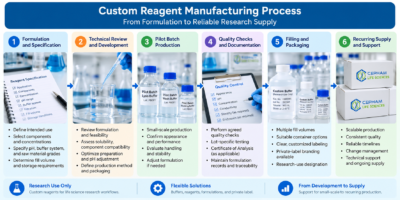
Custom Reagent Manufacturing at Cepham Life Sciences
Cepham Life Sciences supports custom buffers and reagents, formulation and blending, private-label manufacturing, genomic DNA preparation, and plasmid DNA preparation for life science research workflows.
Projects can be discussed around the laboratory’s formulation, intended research application, preferred packaging, anticipated volume, and relevant quality requirements.
The most effective custom project begins with a precise question:
What must this reagent do at the bench, and what evidence will show that it does it consistently?
References
- U.S. Food and Drug Administration (FDA). Distribution of In Vitro Diagnostic Products Labeled for Research Use Only or Investigational Use Only: Guidance for Industry and FDA Staff. Guidance addressing appropriate research-use-only labeling and intended use.
- U.S. Food and Drug Administration (FDA). In Vitro Diagnostic Device Labeling Requirements. Information concerning labeling requirements and research-use-only designations for applicable IVD products.
For Research Use Only
Information in this article is intended for research and educational purposes. Custom reagent specifications, testing requirements, packaging, stability, documentation, and manufacturing approaches depend on the formulation and intended application. Products described as research-use materials are not intended for clinical diagnosis or therapeutic use unless specifically manufactured, documented, and supplied for an applicable regulated purpose.