


How to Avoid BCA Interference in Protein Quantitation

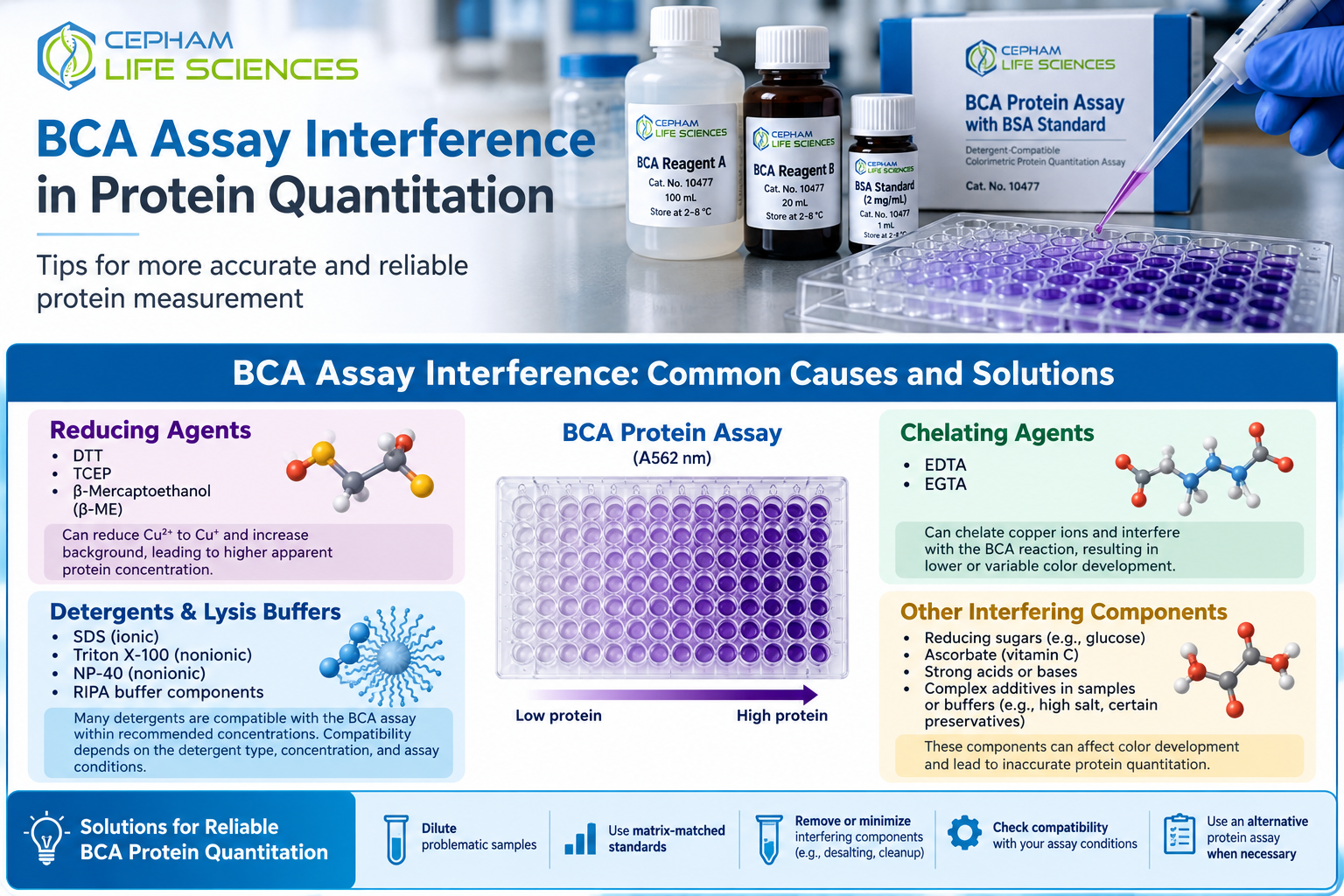
A BCA assay can produce a clean standard curve while still reporting an inaccurate protein concentration. The usual cause is not necessarily pipetting error but sample chemistry. Understanding how to avoid BCA assay interference begins with recognizing that the assay measures copper reduction rather than protein mass directly.
Any sample component that reduces copper independently of protein, binds copper, substantially alters assay pH, or otherwise changes color development can bias the measured protein concentration.
For protein extraction, purification, Western blotting, enzyme assays, and other downstream studies, inaccurate protein quantitation can affect every subsequent normalization step. A sample that appears protein-rich because of reagent interference may be underloaded on a gel, while an underestimated sample can lead to overloaded lanes, poor transfer, or misleading comparisons.
Why BCA Assay Interference Occurs
The bicinchoninic acid (BCA) assay is based on the reduction of Cu²⁺ and Cu⁺ by proteins under alkaline conditions. BCA then chelates Cu1+, producing a purple complex that is typically measured near 562 nm.
Peptide bonds contribute to copper reduction, while certain amino acid residues also influence color formation. This chemistry provides relatively high sensitivity and good compatibility with many common protein sample buffers, but it also creates opportunities for chemical interference.
Nonprotein reducing compounds can reduce Cu²⁺ independently of protein and generate falsely elevated readings. Copper-binding compounds can reduce copper availability and suppress assay response. Strongly acidic or alkaline formulations may also interfere with the reaction conditions.
Importantly, interference depends on the concentration of the component in the final assay, the particular BCA formulation, sample-to-reagent ratio, incubation conditions, and sample dilution. Compatibility should therefore be evaluated for the actual assay being used rather than inferred from the name of the extraction buffer alone.
Common Sources of BCA Assay Interference
| Sample Component | Potential Effect on BCA Assay | Practical Approach |
|---|---|---|
| DTT, TCEP, beta-mercaptoethanol, and other reducing agents | Can reduce copper independently of protein and produce falsely high readings | Quantitate before adding reductant when possible; dilute, clean up, or use a compatible assay |
| EDTA, EGTA, and other copper-binding compounds | May reduce available copper and alter assay response above compatible concentrations | Check assay-specific limits; dilute, reduce concentration, or exchange buffer |
| Detergents | Many are tolerated by BCA assays, but compatibility is concentration- and formulation-dependent | Verify the specific detergent and concentration against the assay instructions |
| Strong acids or bases | Can alter the alkaline reaction environment | Neutralize or dilute when appropriate and verify compatibility |
| Reducing sugars, ascorbate, and other redox-active compounds | May contribute to copper reduction and increase background | Remove, dilute, or use another quantitation method |
| Complex lysis or inhibitor formulations | Multiple components may produce combined matrix effects | Use matrix-matched controls and experimentally verify compatibility |
| High concentrations of selected salts, solvents, or additives | Effects vary considerably with compound and assay formulation | Check manufacturer compatibility data rather than assuming incompatibility |
The table should be treated as a screening guide rather than a universal compatibility specification. Manufacturer instructions for the particular BCA assay remain the appropriate source for maximum compatible concentrations.
Reducing Agents Can Produce False-High Protein Results
Reducing agents are among the most important BCA interferents because they can participate directly in copper reduction.
Dithiothreitol (DTT), beta-mercaptoethanol, tris(2-carboxyethyl)phosphine (TCEP), dithioerythritol (DTE), and other reducing compounds may increase background color and produce an apparent protein concentration higher than the actual concentration.
This problem is particularly relevant when samples are prepared for SDS-PAGE or Western blotting under reducing conditions before protein concentration is measured.
A practical workflow is to measure protein concentration before adding the reducing agent whenever the experimental design permits. When a reductant must be present during extraction or storage, possible approaches include sample dilution, cleanup or buffer exchange, a reducing-agent-compatible assay formulation, or an alternative protein quantitation method.
Do not assume that all BCA formulations have identical tolerance. Compatibility limits can differ substantially among standard BCA, micro-BCA, and reducing-agent-compatible assay formats.
Chelators Can Affect Copper Availability
EDTA, EGTA, citrate, and other metal-binding compounds can interact with copper and may interfere with BCA chemistry when present above assay-compatible concentrations.
However, the presence of a chelator does not automatically make a sample unsuitable for BCA analysis. Compatibility depends on the compound, its concentration, the sample dilution, and the particular assay formulation.
Chelators may be included in protein extraction buffers to inhibit metalloproteases or control divalent-cation-dependent processes. If they are necessary, check the manufacturer’s compatibility limit for the specific assay before changing the extraction formulation.
When interference is suspected, options include reducing the chelator concentration, diluting the sample, exchanging the buffer, or using another compatible protein assay.
Detergents and Lysis Buffers Require Concentration-Specific Evaluation
One advantage of BCA chemistry is its relatively good compatibility with many detergents used for protein extraction.
Common detergents and surfactants such as NP-40-type detergents, Triton-type detergents, CHAPS, SDS, and sodium deoxycholate may be compatible at specified concentrations depending on the assay formulation.
For example, some RIPA-type formulations can be used directly with standard BCA assays under validated conditions. This makes BCA useful for many total-protein lysates.
However, detergent compatibility should never be generalized across all concentrations or assay versions. A complex lysis buffer may also contain reducing agents, chelators, inhibitors, salts, glycerol, chaotropes, or other additives that affect assay performance independently of the detergent itself.
Therefore, evaluate the complete sample matrix, not just its primary detergent.
How to Avoid BCA Interference Before It Reaches the Plate
The most reliable strategy is to make protein quantitation part of the experimental design rather than treating it as an afterthought.
Select a lysis buffer that preserves the target protein while remaining compatible with the intended quantitation and downstream applications.
If a reducing agent is not required during extraction, add it after protein quantitation. If EDTA or EGTA is optional, use only the concentration required for the experimental purpose.
Document all components of the sample buffer, including:
- detergents
- reducing agents
- chelators
- salts
- glycerol
- protease inhibitors
- phosphatase inhibitors
- stabilizers
- carrier proteins
- chaotropes
- other additives
Commercial inhibitor cocktails and prepared buffers may contain components that are not apparent from a shorthand buffer name.
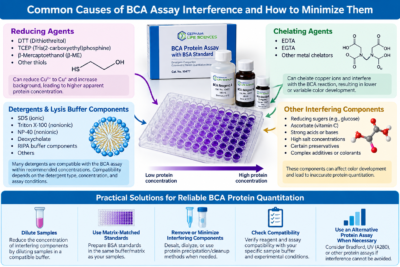
Common Causes of BCA Assay Interference
Use Dilution Carefully to Reduce Interference
For samples already prepared in a potentially incompatible buffer, dilution is often the simplest first approach.
Dilution decreases the concentration of the interfering substance in the assay well. However, it simultaneously decreases protein concentration.
The diluted protein concentration must remain within the reliable working range of the assay. A dilution that eliminates chemical interference but moves the protein concentration below the assay’s useful range does not solve the analytical problem.
A useful approach is to test several sample dilutions and compare the back-calculated protein concentrations.
If the calculated concentration remains reasonably consistent across dilutions within the assay’s linear range, significant matrix interference is less likely. If the calculated concentration changes systematically with dilution, investigate the sample matrix before accepting the result.
Use Cleanup or Buffer Exchange When Dilution Is Not Enough
When dilution cannot reduce the interferent sufficiently, consider removing incompatible components before quantitation.
Possible approaches include:
- desalting
- dialysis
- spin filtration
- ultrafiltration
- precipitation-based cleanup
- buffer exchange
Each method introduces its own potential source of protein loss.
Precipitation may result in incomplete recovery or difficulty resolubilizing some proteins. Membrane-based concentration and buffer-exchange methods may produce nonspecific adsorption or selective losses.
For limited or valuable samples, evaluate recovery using a representative preparation before applying a cleanup procedure routinely.
Match Standards and Blanks to the Sample Matrix
Matrix matching is an important control for protein quantitation.
Whenever practical, prepare protein standards in a buffer that closely matches the composition of the unknown samples rather than preparing standards in water or an unrelated buffer.
For example, if the samples contain a defined concentration of detergent and salt, standards containing the same compatible matrix can help minimize differences between standards and unknowns.
A matrix-matched blank should contain the sample-buffer components but no protein. This can identify background absorbance or color development arising from the buffer itself.
However, blank subtraction cannot correct every form of BCA interference. If an interferent changes the protein-dependent response or alters the slope of the standard curve, subtracting background alone may not restore accurate quantitation.
Keep Incubation Conditions Consistent
Use the same incubation time and temperature for standards, blanks, controls, and unknown samples.
BCA color development depends on reaction conditions, so inconsistent timing or temperature can introduce avoidable variation.
Mix samples thoroughly after adding working reagent and minimize bubbles in microplate wells because bubbles can affect absorbance measurements.
When processing many samples, use a consistent plate-loading sequence or multichannel workflow to minimize differences in reaction time between the first and last wells.
Verify BCA Assay Performance With Controls
A visually acceptable standard curve and duplicate wells do not prove that an unknown sample is free from matrix interference.
Include appropriate controls when accurate quantitation is important.
Spike-Recovery Testing
Add a known amount of protein standard to an aliquot of the sample matrix and determine whether the measured increase agrees reasonably with the expected increase.
Poor recovery may indicate matrix interference, incomplete solubilization, or another analytical problem requiring dilution, cleanup, or an alternative assay.
Serial-Dilution Testing
Measure several dilutions of the same sample that remain within the assay’s working range.
After correcting for dilution, the calculated protein concentration should remain reasonably consistent. A systematic concentration change with dilution is a warning that the sample matrix may be affecting the assay.
Matrix-Matched Controls
When possible, include a control sample with a known or independently estimated protein concentration prepared in the same buffer as the experimental samples.
Together, these controls provide more information than replicate wells alone.
When to Choose an Alternative Protein Assay
BCA is not necessarily the best protein assay for every sample.
| Method | Major strength | Important limitation/consideration |
|---|---|---|
| BCA assay | Good sensitivity and compatibility with many detergents | Sensitive to reducing agents and copper-binding compounds |
| Bradford-type assay | Rapid and often more tolerant of reducing agents | Detergents can interfere; response varies among proteins |
| UV absorbance at 280 nm | Fast and reagent-free | Best suited to relatively pure proteins; affected by nucleic acids, turbidity and other UV-absorbing compounds |
| Fluorescence-based protein assay | High sensitivity; some formulations tolerate difficult matrices | Requires compatible fluorometric instrumentation and assay-specific compatibility verification |
| Reducing-agent-compatible BCA format | Retains BCA-type workflow with greater reductant tolerance | Compatibility remains formulation- and concentration-dependent |
If strong reducing agents must remain in the sample, a reducing-agent-compatible assay or a method based on different chemistry may be preferable.
Bradford-type assays are often less sensitive to reducing agents but may be affected by detergents and can show substantial protein-to-protein variation because dye binding depends on protein composition.
UV absorbance at 280 nm can be useful for relatively pure proteins in simple buffers, but nucleic acids, aromatic compounds, turbidity, and light-scattering particles can compromise the measurement.
Fluorescence-based methods may offer greater sensitivity and useful compatibility with selected sample matrices, but their compatibility limits should also be verified.
A Practical BCA Interference Troubleshooting Strategy
When a BCA result appears inconsistent, work through the following questions:
- Does the sample contain a reducing agent? Check for DTT, TCEP, beta-mercaptoethanol, DTE, reducing sugars, ascorbate, or other redox-active components.
- Does the sample contain a copper-binding compound? Review EDTA, EGTA, citrate, and other chelating components and compare their concentrations with assay-specific compatibility limits.
- Are the detergent and other additives within compatible concentrations? Evaluate the complete buffer rather than assuming compatibility from one component.
- Do standards and blanks match the sample matrix? Differences between standard and sample buffers can introduce systematic bias.
- Does dilution change the back-calculated protein concentration? A dilution-dependent result can indicate matrix interference.
- Does a spike-recovery control behave as expected? Poor recovery suggests that the matrix is altering assay response.
- Would cleanup, buffer exchange, or another assay be more reliable? Avoid forcing BCA chemistry onto a sample that remains fundamentally incompatible.
Build BCA Compatibility Into the Protein Workflow
A repeatable protein quantitation workflow should document the lysis-buffer formulation, sample dilution, standard matrix, blank composition, incubation conditions, assay format, and acceptance criteria for replicate variation.
Before using a new buffer, reducing agent, inhibitor cocktail, or protein extraction formulation in a larger study, test its effect on a standard curve and representative sample.
A short compatibility experiment can prevent inaccurate protein-loading decisions from propagating through electrophoresis, Western blotting, ELISA preparation, enzyme assays, or protein purification workflows.
The most useful BCA result is not simply the one producing the strongest color signal or the best-looking standard curve. It is the result that remains accurate within the chemical environment of the sample being measured.
Cepham Life Sciences provides research products supporting protein extraction, protein quantitation, electrophoresis, Western blotting, biological buffers and reagents, protein purification, and related protein research workflows. For protein quantitation applications, researchers can also explore the BCA Protein Assay with BSA Standard.
For Research Use Only.
References
- Smith PK, Krohn RI, Hermanson GT, et al. Measurement of protein using bicinchoninic acid. Analytical Biochemistry. 1985;150(1):76–85. DOI: 10.1016/0003-2697(85)90442-7
- Wiechelman KJ, Braun RD, Fitzpatrick JD. Investigation of the bicinchoninic acid protein assay: identification of the groups responsible for color formation. Analytical Biochemistry. 1988;175(1):231–237. DOI: 10.1016/0003-2697(88)90383-1
- Thermo Fisher Scientific. Protein Quantitation Assay Compatibility Table. Protein Quantitation Assay Compatibility Table
- Cepham Life Sciences. BCA Protein Assay with BSA Protein Standard — Instruction Manual. Catalog No. 10477-0 and 10477-1.