


Protein Purification Resin Selection Criteria

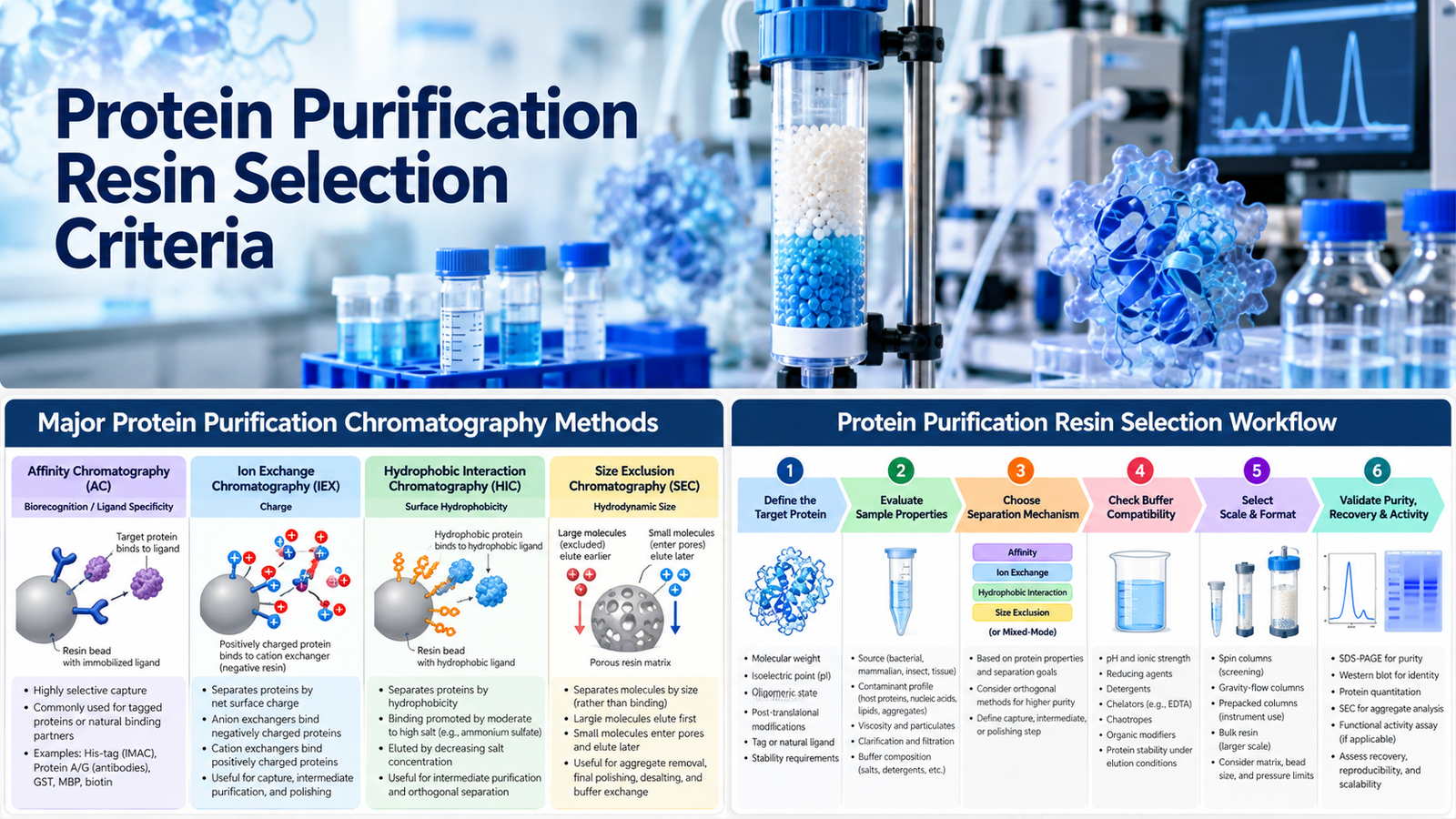
A resin that performs well in a published protocol can still be a poor fit for a different protein, sample matrix, or purification scale. Effective protein purification resin selection begins with the target molecule and the required purity profile, then considers sample composition, buffer compatibility, recovery goals, separation mechanism, and chromatography format.
The lowest-cost resin per milliliter is not necessarily the lowest-cost purification strategy. A resin that requires repeated runs, extensive buffer adjustment, or multiple polishing steps may ultimately consume more time and sample than a more selective alternative.
For research workflows, the objective is generally to obtain sufficient quantity, purity, and functional recovery for downstream characterization, enzymatic assays, immunoassays, structural studies, antibody production, or other protein research applications. A high-capacity resin may be appropriate for initial capture, whereas a higher-resolution resin with lower loading capacity may be better suited to final polishing.
Start Protein Purification Resin Selection With the Target Protein
Before comparing resin chemistries, define the known properties of the target protein. Molecular weight, isoelectric point (pI), oligomeric state, hydrophobicity, post-translational modifications, and stability limits can all influence which separation mechanisms are practical.
Also determine whether the protein contains an affinity tag, naturally binds a specific ligand, requires native protein-protein interactions to remain intact, or must remain within a particular pH or ionic-strength range to preserve activity.
The sample source is equally important. Clarified bacterial lysate, mammalian cell lysate or culture supernatant, insect-cell lysate, tissue extract, and serum-derived material contain very different impurity profiles.
Nucleic acids can increase viscosity and interfere with column flow. Lipids, host-cell proteins, aggregates, proteases, salts, and detergents may reduce binding performance or alter selectivity.
Clarification is therefore not a minor preparatory step. Appropriate centrifugation, filtration, nuclease treatment when suitable, and buffer adjustment can improve loading consistency and protect chromatography performance. A poorly prepared feedstream can make an otherwise appropriate resin appear ineffective.
Compare the Major Protein Purification Resin Types
Protein purification methods exploit different physicochemical properties of the target molecule. Selecting the separation mechanism before selecting a specific resin product can simplify method development.
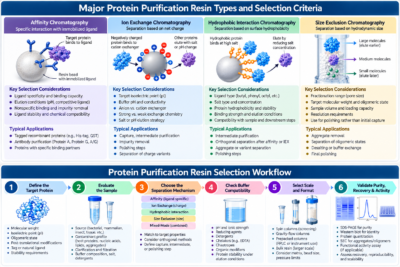
| Resin / Chromatography Type | Primary Separation Principle | Typical Research Use | Important Selection Considerations |
|---|---|---|---|
| Affinity | Specific interaction between target and immobilized ligand | Tagged recombinant proteins, antibodies, proteins with specific binding partners | Ligand specificity, binding capacity, elution conditions, ligand stability, nonspecific binding |
| Ion Exchange (IEX) | Net surface charge | Capture, intermediate purification, impurity removal, polishing | Target pI, buffer pH, conductivity, anion vs. cation exchanger, strong vs. weak exchanger |
| Hydrophobic Interaction (HIC) | Surface hydrophobicity | Intermediate purification, aggregate or variant separation, polishing | Ligand hydrophobicity, salt type and concentration, protein stability |
| Size Exclusion (SEC) | Hydrodynamic size | Aggregate removal, final polishing, desalting or buffer exchange | Fractionation range, sample volume, column dimensions, resolution requirements |
| Mixed-Mode / Multimodal | Two or more interaction mechanisms | Difficult separations and polishing of complex samples | Combined selectivity, buffer conditions, method-development requirements |
No chromatography mode is universally superior. Each separates proteins according to a different property, so complementary mechanisms are often combined to improve purity without sacrificing excessive recovery.
Affinity Resins for Selective Capture
Affinity chromatography is often the most direct starting point when the target protein contains a compatible tag or has a specific binding partner.
Immobilized metal affinity chromatography (IMAC) is widely used for His-tagged recombinant proteins. Protein A, Protein G, and Protein A/G resins are commonly used for immunoglobulin purification, although antibody species, subclass, isotype, and format should be checked before choosing a ligand.
Glutathione, maltose, biotin-binding systems, and other ligand-based resins may be appropriate for specific fusion tags or target molecules.
Affinity chromatography can substantially reduce sample complexity in a single step, but affinity capture does not guarantee that the final preparation is suitable for every downstream application. Host-cell proteins, nucleic acids, aggregates, antibody fragments, leached ligand or metal, and tag-related impurities may remain.
When the purified material will be used in sensitive functional, structural, or analytical experiments, an orthogonal second purification step may improve the final preparation.
Elution conditions deserve as much attention as binding specificity. Low-pH elution from Protein A or Protein G resins may affect acid-sensitive proteins or antibodies. IMAC elution with imidazole is convenient, but metal ion selection, imidazole concentration, pH, and nonspecific binding should be optimized for the target.
If an affinity tag will be removed, the purification strategy should also account for separation of the cleaved target from the free tag, protease, and uncleaved material.
Ion Exchange Resins for Capacity and Resolution
Ion exchange chromatography separates proteins according to net surface charge under defined pH and ionic-strength conditions.
In anion exchange chromatography, negatively charged proteins interact with positively charged groups on the resin. In cation exchange chromatography, positively charged proteins interact with negatively charged resin groups.
As a practical starting principle, a protein at a pH above its pI generally carries a net negative charge and may bind to an anion exchanger. At a pH below its pI, the protein generally carries a net positive charge and may bind to a cation exchanger. Experimental screening remains important because actual protein behavior also depends on surface charge distribution, buffer composition, and protein structure.
Strong and weak ion exchangers refer to the ionization behavior of the resin’s functional group rather than simply to how strongly a protein binds. Strong ion exchangers remain charged over a broader pH range, while weak exchangers change ionization with pH and can provide different selectivity.
Neither is universally better.
Conductivity is another major variable. Excessive salt in the loading buffer can weaken electrostatic interactions and reduce target binding. Bound proteins are commonly eluted by increasing salt concentration or changing pH.
Step elution is convenient for routine purification and scale-up, whereas gradient elution can provide more information during method development and improve separation of closely related species.
Hydrophobic Interaction Resins for Orthogonal Separation
Hydrophobic interaction chromatography (HIC) separates proteins according to differences in exposed surface hydrophobicity.
Unlike many other chromatography modes, HIC commonly begins under moderate-to-high salt conditions that promote hydrophobic interactions between the protein and the resin. Proteins are typically eluted by decreasing the salt concentration.
This makes HIC particularly useful after ammonium sulfate precipitation or other high-salt processing steps because the sample may require less adjustment before loading.
HIC can also provide an orthogonal separation after affinity or ion exchange chromatography because it separates according to a different protein property.
Ligand chemistry affects binding strength. Butyl, phenyl, octyl, and other hydrophobic ligands can provide different selectivity, while ligand density and base matrix also influence resin behavior.
More hydrophobic is not automatically better. Excessively strong binding may require conditions that decrease recovery or compromise protein stability. For a labile target, screening relatively mild HIC conditions first can reduce the risk of irreversible adsorption or loss of activity.
Size Exclusion Resins for Aggregate Removal and Final Polishing
Size exclusion chromatography (SEC), also called gel filtration, separates molecules according to hydrodynamic size rather than binding them to the resin.
SEC is commonly used for aggregate removal, separation of oligomeric states, final polishing, desalting, and buffer exchange. Because sample volume and loading capacity are limited compared with many binding-based chromatography methods, SEC is generally more useful after the target protein has already been enriched.
Pore-size selection is critical. The target and relevant contaminants should fall within an appropriate fractionation range of the selected resin. A matrix designed primarily for very large complexes may provide limited useful resolution for a much smaller protein.
Sample volume also strongly affects resolution. Excessive loading volume broadens peaks and reduces separation between monomer, aggregate, and lower-molecular-weight species.
For analytical or preparative SEC, avoid assuming that the resin with the widest fractionation range will provide the best separation. Resolution around the molecular-size range of interest is usually more important.
Consider Mixed-Mode Resins for Difficult Separations
Mixed-mode or multimodal chromatography resins combine more than one interaction mechanism within the same stationary phase, such as ionic and hydrophobic interactions.
These resins can be useful when conventional affinity, ion exchange, or HIC methods do not provide sufficient selectivity, or when researchers want to resolve difficult impurities using an orthogonal mechanism.
The additional selectivity can be valuable, but method development may also be less intuitive because multiple interactions respond simultaneously to pH, conductivity, and other buffer variables.
For unfamiliar proteins, mixed-mode chromatography is generally best evaluated through controlled screening rather than selected solely from theoretical protein properties.
Match Resin Format to Purification Scale and Workflow
Resin chemistry alone does not determine purification performance. Bead size, pore structure, matrix composition, pressure tolerance, flow properties, and available format influence throughput and reproducibility.
Spin columns and small gravity-flow columns are convenient for screening and small research preparations.
Prepacked chromatography columns provide more controlled bed dimensions and are useful when reproducible flow, gradient development, or instrument-based chromatography is required.
Bulk resin becomes attractive when a method is being transferred to larger columns, used repeatedly, or scaled to higher sample volumes.
Agarose-based matrices are widely used for biomolecule purification because of their hydrophilic character and compatibility with many aqueous conditions. Synthetic polymer matrices can provide different mechanical strength, pore structures, pressure tolerance, and chemical resistance.
The appropriate matrix depends on the protein, equipment, sample viscosity, operating pressure, and cleaning requirements.
Evaluate Dynamic Binding Capacity, Not Capacity Alone
Catalog specifications can be useful for comparing candidate resins, but maximum or static binding capacity does not necessarily predict performance during an actual chromatography run.
Dynamic binding capacity reflects how much target can be captured under defined flow or residence-time conditions before a specified degree of breakthrough occurs.
Actual capacity can change with residence time, sample conductivity, pH, target concentration, competing proteins, feed composition, and temperature.
For repeated or larger-scale purification, a small breakthrough experiment under realistic loading conditions may provide more useful information than relying solely on the manufacturer’s maximum binding-capacity specification.
Capacity should also be considered alongside recovery and resolution. A very high-capacity resin provides little benefit if its selectivity is inadequate or if elution conditions damage the target protein.
Assess Buffer and Chemical Compatibility
The selected resin must tolerate both the sample buffer and the conditions required for washing, elution, regeneration, storage, and cleaning.
Review compatibility with:
- reducing agents
- detergents
- chelators
- chaotropes
- salts
- organic modifiers
- extreme pH conditions
before committing valuable sample to a column.
For example, chelating agents such as EDTA can interfere with many immobilized-metal affinity systems by binding metal ions. Detergents may alter hydrophobic or affinity interactions, and reducing agents may be acceptable for some resin chemistries but problematic for others.
Manufacturer-specific compatibility information should therefore be checked for the actual resin being used rather than assuming that all products within a chromatography class tolerate identical conditions.
Protein stability places another limit on purification design. A target may precipitate at low ionic strength, lose activity during acidic elution, or aggregate during concentration.
In these situations, the resin with the highest theoretical selectivity may not produce the best usable protein preparation. A slightly less selective purification step that maintains the target in a soluble and active state may provide better overall recovery.
Build Protein Purification Resin Selection Into Small-Scale Screening
For an unfamiliar target, small-scale parallel screening is often more informative than extensive optimization of a single resin selected from theoretical considerations.
Test two or three mechanisms that fit the known properties of the protein using the same starting material and consistent analytical criteria.
A practical screening panel might include:
- an affinity resin when an appropriate tag or ligand is available;
- an anion or cation exchanger selected according to estimated protein charge behavior;
- HIC when hydrophobicity may provide useful orthogonal separation; and
- SEC as a polishing option when aggregates, oligomers, or molecular-size variants are important.
Evaluate more than purity alone.
SDS-PAGE can assess enrichment and major contaminants, while Western blotting can help confirm target identity. Protein quantitation, SEC analysis, or functional activity assays may also be necessary to assess recovery, aggregation, and biological activity.
Record target recovery, purity, flow behavior, buffer requirements, processing time, and reproducibility. These observations provide a stronger basis for scale-up decisions than a single purity measurement.
Common Protein Purification Resin Selection Errors
Several recurring mistakes can make a suitable resin appear ineffective.
Selecting a resin solely because the target can bind. Binding is only one part of the separation. The contaminant profile determines whether binding produces useful purification.
Ignoring the sample buffer. High conductivity can prevent efficient ion-exchange binding, while incompatible chelators may compromise IMAC performance.
Optimizing capacity while ignoring recovery. Higher binding capacity does not improve the process if the target cannot be efficiently eluted in an active form.
Using SEC as a high-capacity capture method. SEC generally performs best for polishing or buffer exchange after the target has already been enriched.
Overloading the resin or column. Exceeding practical capacity can reduce purity and resolution even when the target continues to bind.
Assuming a successful protocol will transfer unchanged. Changes in expression system, cell line, culture conditions, protein extraction, or expression level can change the impurity profile and require purification adjustments.
A Practical Protein Purification Resin Selection Strategy
A useful way to approach protein purification resin selection is to ask the following questions in order:
- What property distinguishes the target from the major contaminants? Consider affinity, charge, hydrophobicity, and molecular size.
- What conditions can the protein tolerate? Define acceptable pH, salt concentration, detergents, reducing agents, temperature, and elution conditions.
- Is the chromatography step intended for capture, intermediate purification, or polishing? The performance priorities are different at each stage.
- What capacity and resolution are actually required? Avoid choosing a resin solely because it has the highest catalog binding capacity.
- Is the sample compatible with the resin and loading conditions? Consider conductivity, viscosity, particulates, chelators, detergents, and other buffer components.
- What format matches the scale? Select between spin columns, gravity-flow formats, prepacked columns, or bulk resin according to sample volume and equipment.
- How will success be measured? Define acceptable recovery, purity, biological activity, aggregate content, and reproducibility before screening.
The most useful resin is therefore not simply the one with the strongest binding or highest capacity. It is the resin that fits the complete workflow: it operates under conditions the protein tolerates, separates the impurities that matter, provides acceptable recovery, and delivers reproducible material for the next experiment.
Careful initial screening turns resin selection from a trial-and-error purchasing decision into a controlled part of protein purification method development.
Cepham Life Sciences provides research products supporting protein extraction, protein quantitation, electrophoresis, Western blotting, biological buffers and reagents, protein purification, and related protein research workflows. For protein quantitation applications, researchers can also explore the BCA Protein Assay with BSA Standard.
For Research Use Only.
References
- Cytiva. Protein Purification Handbook. Principles and methods for selecting and combining chromatography techniques for protein purification.
- Cytiva. Ion Exchange Chromatography: Principles and Methods. Guidance on ion exchange media selection, binding conditions, method development, and protein purification.
- Cytiva. Hydrophobic Interaction Chromatography: Principles and Methods. Guidance on HIC resin selection, ligand hydrophobicity, salt conditions, and method development.
- Cytiva. Size Exclusion Chromatography: Principles and Methods. Guidance on SEC media selection, fractionation ranges, sample loading, and resolution.
- Cepham Life Sciences. BCA Protein Assay with BSA Protein Standard — Instruction Manual, Rev. 6. Catalog No. 10477-0 and 10477-1.